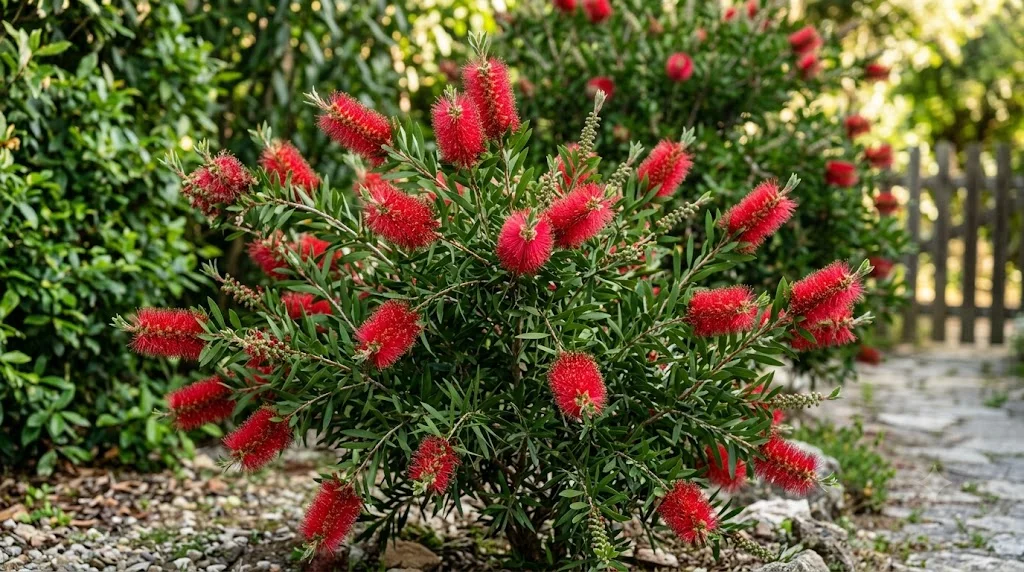

Water and nutrients strongly influence the density, flowering capacity, and overall resilience of lemon bottlebrush. The plant appreciates regular moisture during active growth but reacts poorly to stagnant, oxygen-depleted soil. Fertiliser should support firm, balanced development rather than produce excessive soft foliage. The best care routine responds to soil condition, weather, root volume, and seasonal growth instead of following a fixed calendar blindly.
Understanding moisture requirements
Lemon bottlebrush is often described as drought tolerant, but this mainly applies to established plants growing in open ground. Young specimens have limited root systems and require reliable moisture during their first seasons. Container plants are also vulnerable because their roots cannot explore deeper soil reserves. Their water demand may increase dramatically during hot, windy weather.
The soil should be allowed to lose some surface moisture between waterings while remaining slightly moist deeper down. Constant saturation excludes oxygen and encourages root decline. Complete drying, on the other hand, can cause leaf curling, bud loss, and premature shedding. The aim is a stable cycle of thorough watering followed by moderate drying.
Testing the growing medium by touch is more useful than judging only the surface appearance. Insert a finger several centimetres into the soil or use a wooden probe to assess deeper moisture. Large containers may remain wet in the centre even when the top looks dry. This hidden moisture is one reason why overwatering frequently occurs in cool conditions.
Rainfall does not always wet a dense container root ball effectively. Leaves and branches may divert light rain away from the compost, leaving the centre dry. After rain, the medium should still be checked rather than assumed to be adequately watered. Deep, penetrating moisture is more valuable than repeated shallow wetting.
More articles on this topic
Watering through the seasons
In spring, water demand rises as new shoots and flower buds develop. Increase irrigation gradually as temperatures become warmer and the plant resumes active growth. Sudden severe drying during this period can reduce the number and quality of flowers. Soil should remain evenly moist without being continuously waterlogged.
Summer watering may be required several times a week in open ground and daily in exposed containers. Apply enough water to moisten the entire root zone and allow excess to drain away. Watering early in the morning reduces evaporation and prepares the plant for daytime heat. Evening irrigation can also be effective, provided foliage is not left persistently wet in cool conditions.
Autumn watering should be reduced as growth slows and temperatures fall. The plant still needs enough moisture to prevent root desiccation, particularly in sheltered pots that receive little rainfall. Long periods of saturated soil become increasingly dangerous as evaporation declines. Check conditions before every application instead of continuing the summer routine.
Winter watering should be cautious, especially for plants kept in cool indoor accommodation. The compost may take much longer to dry because the plant is using less water. Small amounts applied only when needed are safer than heavy, frequent watering. The root ball must not become bone dry, but it should never remain cold and saturated.
More articles on this topic
Selecting suitable water
Rainwater is ideal because it is usually soft and contains fewer dissolved salts than tap water. This is particularly beneficial in areas where mains water is hard or alkaline. Long-term use of hard water can raise the pH of container compost and contribute to iron deficiency. Collecting clean rainwater helps maintain a more favourable root environment.
Tap water can still be used successfully when it is the only practical option. Allowing it to stand may bring it closer to room temperature, reducing stress to warm roots. It does not remove all dissolved minerals, but it can improve watering comfort during cold weather. Periodic flushing with rainwater helps wash accumulated salts from the compost.
Water temperature deserves attention for plants overwintered indoors. Very cold water applied to a cool root system can slow activity and increase stress. Lukewarm or room-temperature water is safer, particularly in heated conservatories. Extremely warm water should also be avoided because it can damage fine roots.
Salt deposits may appear as a pale crust on the compost surface or around the rim of the pot. This indicates that minerals from water or fertiliser are accumulating as moisture evaporates. Removing the upper layer and thoroughly flushing the container can reduce the concentration. Severe cases may require repotting into fresh growing medium.
Fertilising for balanced growth
Begin feeding in spring when new growth becomes visible. A balanced fertiliser formulated for flowering shrubs or Mediterranean container plants is usually suitable. Products containing nitrogen, phosphorus, potassium, and trace elements provide more complete nutrition than simple high-nitrogen feeds. Always follow the recommended dilution because concentrated fertiliser can scorch roots.
Nitrogen promotes leaves and shoots, but excessive amounts reduce flowering and produce soft, vulnerable growth. Phosphorus supports root activity and reproductive development, while potassium contributes to flower quality and tissue strength. The correct balance is more important than maximising any single nutrient. Moderate feeding consistently produces better long-term results than occasional heavy doses.
Slow-release fertiliser offers convenient nutrition for container plants over several months. It should be mixed or placed according to the manufacturer’s instructions and adjusted for pot volume. Liquid feeding can then be used sparingly if growth or foliage indicates additional need. Combining full rates of both slow-release and liquid products may lead to overfertilisation.
Outdoor plants growing in fertile soil often need less supplementary feeding. A spring application of mature compost or a controlled-release fertiliser may be sufficient. Plants in poor, sandy soil can benefit from additional nutrition because rainfall washes minerals downward quickly. Feeding should stop by late summer in cooler climates so that new growth can mature before winter.
Recognising and correcting nutrient problems
Pale young leaves with darker green veins often indicate reduced iron availability. This condition is common in alkaline soil or compost repeatedly watered with hard water. An iron chelate may provide temporary improvement, but the underlying pH problem must also be addressed. Rainwater, fresh acidic compost, and appropriate fertiliser usually give longer-lasting results.
Uniform yellowing of older leaves may indicate nitrogen shortage, root stress, or natural ageing. Before applying fertiliser, check whether the soil is waterlogged or compacted. Damaged roots cannot absorb nutrients efficiently, even when plenty are present. Correcting drainage is therefore often more important than adding additional feed.
Brown leaf margins can result from salt accumulation, excessive fertiliser, drought, or hot drying winds. Inspect the compost and review recent feeding before making further applications. Flush the root zone thoroughly if excess salts are suspected. Damaged leaves will not recover, but healthy new growth confirms that conditions have improved.
Weak flowering despite lush green growth usually suggests too much nitrogen, insufficient sunlight, or poorly timed pruning. Reducing fertiliser alone may not solve the problem if the plant remains shaded. Evaluate the entire care routine, including watering, light, and branch maturity. Balanced conditions allow the plant to convert healthy vegetative growth into abundant flower production.