
The monkey puzzle tree is an extraordinary evergreen conifer valued for its architectural shape, sharply pointed foliage, and unmistakably prehistoric appearance. Native to the cool, moist regions of Chile and Argentina, it can become an impressive long-lived specimen when planted in suitable conditions. Although established trees are generally resilient, young plants require thoughtful care while their roots spread and their crown develops. Understanding the tree’s natural habitat makes it much easier to provide the balanced moisture, light, soil, and protection it needs.
Understanding its growth habit and long-term needs
A young monkey puzzle tree often grows slowly during its first few years, especially after transplantation. Much of its early energy is directed toward establishing a strong root system rather than producing rapid visible growth. Once settled, it may form a more consistent annual extension from the central leader and side branches. Gardeners should therefore judge its progress over several seasons rather than expecting immediate results.
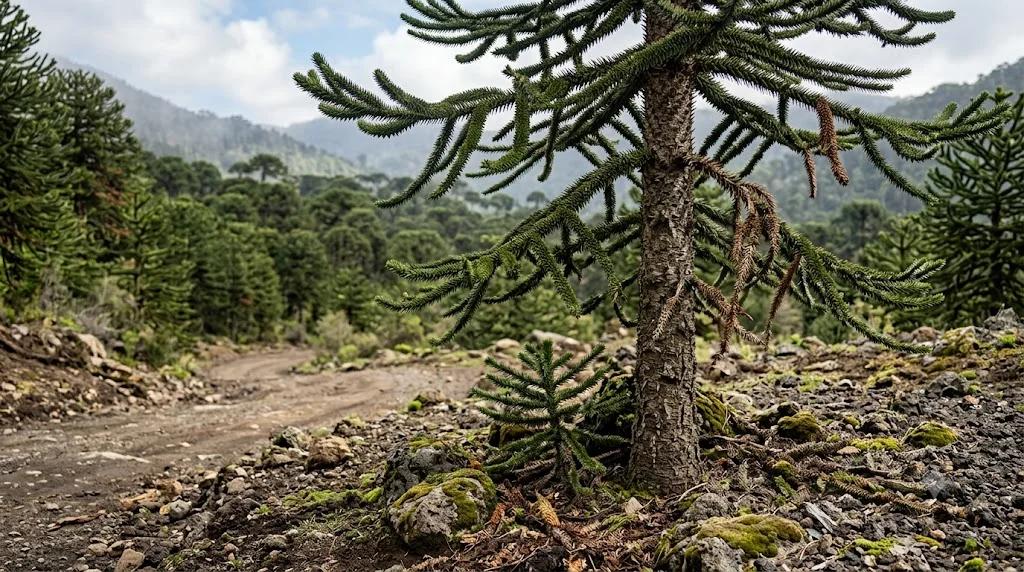
The tree develops a distinctive symmetrical form with branches arranged in regular tiers around a single upright trunk. Its thick, triangular leaves remain attached for many years and cover the branches densely. These leaves are tough, leathery, and sharply pointed, so the tree needs enough space to be approached and maintained safely. Planting it beside a narrow path or frequently used seating area can become inconvenient as the canopy expands.
Mature specimens can reach considerable height and width, although growth rates vary with climate, soil, exposure, and moisture availability. A tree planted in an open lawn may develop a broad, balanced crown, while one crowded by buildings or other trees can become uneven. Its long-term dimensions should be considered before planting because established specimens are difficult to relocate. Adequate spacing also improves air circulation and reduces competition for water and nutrients.
Monkey puzzle trees are usually grown as single-trunk specimens, and the central leader is essential to their natural form. Damage to the growing tip may result in several competing shoots or a permanently irregular crown. Protecting the uppermost shoot from accidental breakage is particularly important in young trees. Staking, pruning, and nearby maintenance should always be carried out without rubbing or injuring the leader.
More articles on this topic
Choosing the right growing environment
The most suitable position is open, bright, and protected from extremely drying winds. Monkey puzzle trees perform especially well in areas with mild summers, reliable rainfall, and relatively humid air. They can tolerate wind once established, but young specimens may suffer from desiccation or root movement in exposed gardens. A site with good light and some shelter generally produces the healthiest, most symmetrical growth.
Cold tolerance improves as the tree matures and becomes fully established. Young trees are more vulnerable to severe frost, frozen soil, and sudden temperature changes than older specimens. A sheltered microclimate can make a significant difference in regions near the colder limit of cultivation. Low-lying frost pockets, where cold air accumulates on still nights, are less suitable than gently elevated ground.
The tree is not an ideal choice for hot, dry inland gardens unless irrigation and wind protection can be provided. Prolonged heat combined with dry soil may cause browning, reduced growth, and stress at the branch tips. Reflected heat from walls, paving, or gravel can further intensify these problems. A location with cooler root conditions and consistent moisture is preferable in warm climates.
Coastal gardens may suit the species because of their mild temperatures and humid air, but direct salt exposure can damage young foliage. Salt-laden winds may scorch the leaves and dry the outer branches. Planting behind a permeable windbreak can reduce this stress without creating severe turbulence. The tree should still receive ample light and should not be enclosed in a permanently damp, stagnant corner.
More articles on this topic
Providing suitable soil conditions
Monkey puzzle trees prefer deep, moderately fertile soil that holds moisture without remaining waterlogged. Loam-based soils are usually ideal because they combine moisture retention with adequate aeration. Sandy ground can also be suitable when improved with organic matter and watered consistently during establishment. Heavy clay requires careful assessment because poor drainage around the roots can lead to decline.
Soil structure is often more important than exceptionally high nutrient content. Roots need access to both moisture and oxygen, especially during cool, wet periods. Compacted soil limits root development and can leave water standing around the planting hole. Broadly loosening the surrounding ground before planting is more beneficial than digging an excessively deep, narrow pit.
The species generally tolerates mildly acidic to neutral soil and can often grow in slightly different conditions when drainage is good. Extremely alkaline ground may contribute to nutrient deficiencies and weak, pale growth. In such situations, adding surface organic matter can gradually improve biological activity, although it will not completely change the underlying soil chemistry. Regular observation of foliage colour is useful for detecting developing problems.
A mulch of composted bark, leaf mould, or mature garden compost helps maintain even soil moisture. It also moderates soil temperature and reduces competition from grass and weeds. The mulch should cover a wide area because the active roots extend beyond the immediate base of the trunk. It must not be piled against the bark, as constant moisture around the stem can encourage decay.
Supporting healthy establishment
Newly planted trees need consistent attention for several growing seasons. Their original root ball occupies only a small area and can dry out even when the surrounding soil appears moist. Water should be applied slowly and deeply so that the entire root zone becomes evenly damp. Frequent shallow sprinkling encourages surface rooting and is less useful during dry weather.
The planting area should be kept free from vigorous grass because turf competes strongly for water. A broad mulched circle gives the tree a better chance to develop new roots into the surrounding soil. Weed removal should be carried out carefully to avoid damaging shallow roots. Herbicide contact with green bark or foliage must also be avoided.
Staking may be needed on exposed sites, but it should support the root system rather than immobilise the whole trunk. A low stake with a flexible tie allows some natural movement, which encourages the trunk to strengthen. Ties should be inspected regularly because they can tighten as the tree grows. Stakes are normally removed once the roots anchor the tree securely.
Young specimens should be checked after storms, prolonged rain, heatwaves, and severe frost. Early signs of stress include dull foliage, browning tips, leaning, loosening soil, or cracks around the root ball. Correcting a problem promptly is usually easier than reviving a tree after substantial decline. Routine observation is one of the most valuable parts of long-term care.
Managing moisture throughout the year
The tree appreciates steady moisture during spring and summer, particularly while new shoots are developing. The soil should remain evenly moist but not saturated for long periods. Deep watering at wider intervals is usually better than applying small amounts every day. The exact frequency depends on rainfall, soil texture, temperature, wind, and the size of the root system.
During hot weather, moisture loss can be considerable because the dense evergreen crown continues to transpire. Newly planted trees may require careful watering even after short dry spells. Established specimens are more tolerant of temporary dryness, but repeated drought can weaken the outer branches and reduce annual growth. Mulching greatly improves the soil’s ability to retain water between irrigations.
Autumn watering is important when the season has been unusually dry. Evergreen foliage continues to lose moisture during mild winter periods, even though root activity slows in cold soil. A tree entering winter with severely dry roots is more vulnerable to cold and wind damage. Moist soil also changes temperature more gradually than very dry ground.
Winter irrigation is rarely needed in climates with normal rainfall, but container-grown or recently planted specimens may require occasional checks. Water should not be applied to frozen or already saturated soil. Drainage channels may be necessary if heavy rain repeatedly collects around the base. Persistent standing water is more dangerous than a brief dry surface.
Seasonal maintenance and routine observation
Spring is the best time to assess winter damage and examine the condition of the central leader. Dead or clearly broken material can be removed with clean tools while preserving healthy branch collars. Mulch can be renewed after the soil has warmed slightly and received sufficient moisture. This is also a suitable time to check stakes and ties around younger trees.
Summer care mainly involves monitoring water availability and watching for heat stress. Browning may begin on the most exposed side of the canopy when hot winds repeatedly remove moisture. Irrigation should wet the deeper soil rather than only cooling the surface. Mechanical damage from mowers, strimmers, and garden tools must be prevented throughout the growing season.
Autumn provides an opportunity to clear heavy accumulations of fallen leaves from neighbouring trees. A light organic layer is beneficial, but thick, wet debris packed against the trunk can restrict airflow. Mulch should be spread evenly and kept slightly away from the bark. Any loose ties or unstable stakes should be corrected before winter storms begin.
Winter protection should focus on young trees rather than enclosing mature specimens unnecessarily. Temporary windbreak fabric may help in very exposed sites, provided air can still circulate. Heavy coverings placed directly on the branches can trap moisture, deform growth, or break the shoot tips under snow. Snow should be removed gently only when its weight threatens to bend or split branches.
Recognising and preventing common care mistakes
Overwatering is one of the most frequent causes of poor performance in heavy or compacted ground. Symptoms may include dull foliage, reduced growth, branch decline, and gradual browning. Adding more water without checking the soil can worsen the problem. Drainage, soil structure, and root condition should always be considered before changing the irrigation schedule.
Planting too deeply is another serious mistake. The upper root flare should remain close to the finished soil level and should never be buried beneath thick soil or mulch. Deep planting reduces oxygen around the trunk base and can encourage bark deterioration. A tree that appears to emerge from the ground like a straight pole may be positioned too low.
Excessive feeding can produce weak, unbalanced growth rather than improving health. Monkey puzzle trees usually need moderate nutrition, particularly when the soil contains organic matter and supports steady growth. Strong fertilisers placed close to the roots may cause salt injury or rapid growth that is vulnerable to winter damage. Feeding should respond to an identified need rather than being applied automatically.
Unnecessary pruning can permanently spoil the tree’s natural architecture. Removing healthy lower branches exposes the trunk and changes the balanced tiered form. Cutting back the leader can create competing tops that are difficult to correct. The best approach is to choose a suitable site, provide consistent care, and allow the tree to develop according to its natural habit.