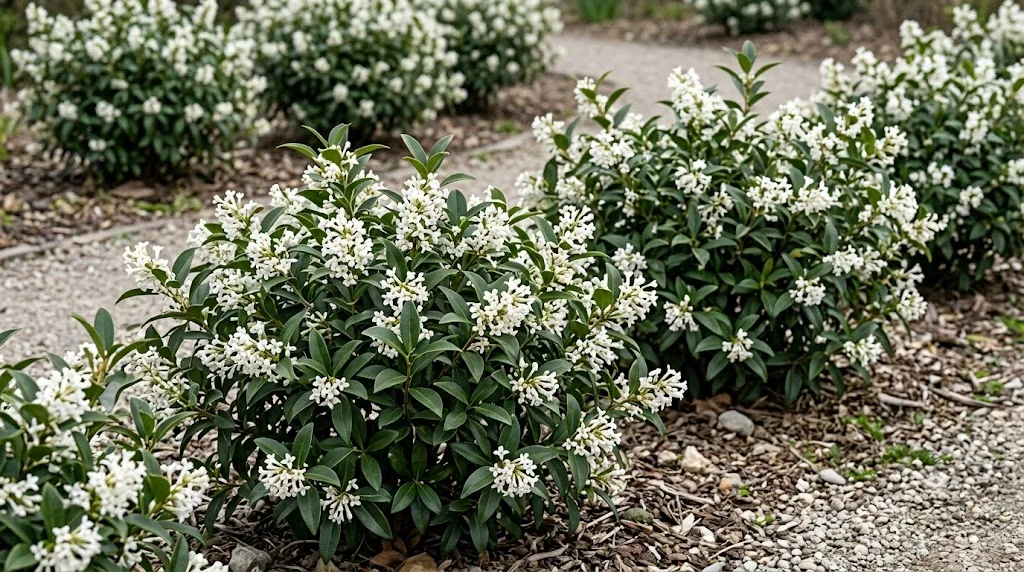

Burkwood osmanthus naturally develops a dense, rounded framework, so pruning should refine its form rather than dominate its growth. Light, correctly timed cutting maintains size, removes damaged wood, improves airflow, and encourages balanced branching. Excessive or poorly timed pruning can reduce flowering because developing buds are removed with the shoots. The most successful approach combines selective annual maintenance with gradual renovation only when an older shrub has become overgrown.
The shrub responds well to careful pruning, but its moderate growth rate means that mistakes may take time to disappear. Before cutting, it is worth standing back and identifying the natural outline, crowded areas, and branches that genuinely require attention. Random shortening often produces a lumpy surface and unnecessary regrowth. Each cut should have a clear purpose.
Clean, sharp secateurs are suitable for most shoots, while loppers or a pruning saw may be required for older branches. Blades should be disinfected when diseased wood has been removed. Crushed or torn cuts heal more slowly and can become entry points for decay. Tools must also be sized appropriately so that thick branches are not forced between small blades.
Pruning intensity should reflect the condition of the plant. A healthy young shrub may need only minimal shaping, while an old neglected specimen may require a staged renovation. Formal hedges need more regular trimming than free-standing shrubs. In every case, preserving sufficient healthy foliage supports recovery.
The best time to prune
The main pruning period is immediately after the spring flowers have faded. Cutting at this time removes relatively few future flower buds and gives new shoots a long season in which to mature. The plant can rebuild its canopy before winter. Flowering should be allowed to finish before substantial shaping begins.
More articles on this topic
Light removal of dead, broken, or dangerous branches can be carried out whenever necessary. Frost-damaged growth is best left until spring growth reveals the extent of injury. Cutting too early may remove living tissue or stimulate vulnerable shoots. Once healthy buds begin to expand, the boundary between dead and live wood is clearer.
Late-summer pruning should be limited because it may encourage soft regrowth. These young shoots may fail to harden before cold weather and can suffer winter dieback. Autumn pruning also removes foliage that helps the shrub store energy. Major work should therefore not be postponed until the end of the season.
Winter pruning is generally unnecessary for healthy Burkwood osmanthus. Severe cuts made during cold weather may remain exposed for long periods before active healing begins. Evergreen foliage can also suffer additional stress after a large reduction. Waiting until after flowering is safer in most situations.
Shaping young and established shrubs
Young shrubs benefit from formative pruning that creates a balanced framework. Weak, crossing, inward-growing, or closely competing shoots can be removed early. This prevents congestion and reduces the need to cut thick branches later. The natural leader and strongest structural shoots should usually be retained.
More articles on this topic
To shorten a branch, make the cut just above an outward-facing bud or a well-positioned side shoot. This directs new growth away from the centre and helps maintain an open, rounded form. Leaving long stubs creates dead sections that heal poorly. Cutting too close to a bud can also damage it.
Established free-standing shrubs usually need only selective thinning and modest height control. Removing a few branches back to their point of origin preserves a natural appearance. Cutting every shoot to the same outer line creates dense surface growth and a shaded interior. Selective cuts allow light to reach deeper into the crown.
Hedge plants can be trimmed more evenly, but the base should remain slightly wider than the top. This shape allows light to reach the lower leaves and reduces the risk of a bare base. The sides should not be cut into a top-heavy profile. Regular light trimming is better than allowing the hedge to overgrow and then cutting it back severely.
Renovating and cutting back overgrown plants
An overgrown shrub should first be assessed for health, structure, and the reason it became unsuitable. If the plant is simply too large for its site, repeated hard pruning may create permanent maintenance problems. Relocation or replacement can sometimes be more practical. Renovation is most worthwhile when the shrub is healthy and has enough space to regrow.
Gradual renovation involves removing a portion of the oldest stems near their base after flowering. Younger shoots are retained to maintain foliage and provide the future framework. The process can be repeated over two or three seasons. This method reduces shock and keeps the shrub reasonably attractive during recovery.
Burkwood osmanthus can often produce new shoots from older wood, but the response is not always perfectly even. Severe cutting may leave temporary bare areas and stimulate strong upright growth. These shoots should be thinned and directed rather than all being shortened at the same height. Careful follow-up pruning rebuilds a balanced crown.
After renovation, the plant needs stable moisture and moderate nutrition. A mulch supports root conditions, while excessive fertiliser should be avoided because it encourages weak, congested regrowth. New shoots should be monitored through the season and protected from severe drought. With patient, staged work, an old shrub can regain a dense and manageable form.