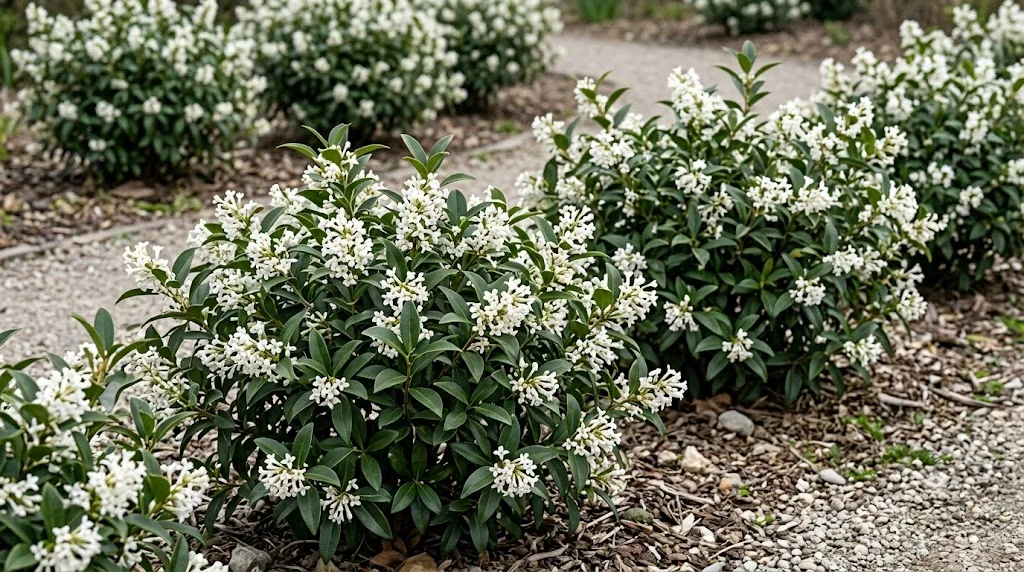

Burkwood osmanthus is a refined evergreen shrub valued for its glossy foliage, compact habit, and intensely fragrant spring flowers. It develops slowly but steadily, eventually forming a dense, rounded plant that can serve as a specimen, informal screen, clipped hedge, or structural element in a mixed border. Although the shrub is generally dependable once established, its performance is strongly influenced by soil drainage, shelter, moisture management, and the timing of routine care. Understanding these needs makes it much easier to maintain healthy foliage and encourage reliable flowering year after year.
Burkwood osmanthus usually reaches a moderate height and spread, although its final dimensions depend on climate, soil quality, pruning, and the amount of competition from neighbouring plants. Its growth is naturally dense, with leathery, dark green leaves that remain on the shrub throughout the year. The small white flowers may appear modest from a distance, but their rich fragrance can fill a sheltered garden in spring. This combination of evergreen structure and seasonal scent makes the shrub especially useful near entrances, paths, patios, and frequently used seating areas.
The plant is relatively tolerant once mature, but it should not be treated as completely maintenance-free. Young shrubs require attentive watering, protection from severe exposure, and careful control of weeds around the root zone. Older plants usually cope better with temporary dryness, moderate shade, and occasional pruning. Even established specimens, however, can decline when planted in persistently wet soil or exposed to severe drying winds.
A balanced care programme should support the entire plant rather than focusing only on flowers or foliage. Good drainage protects the roots, appropriate light maintains dense growth, and steady moisture prevents stress during establishment. Moderate feeding encourages healthy development without producing weak, soft shoots. Pruning, mulching, winter protection, and regular inspection complete the routine and help prevent small problems from becoming serious.
Choosing a suitable position
Burkwood osmanthus performs best in a warm, sheltered part of the garden where it receives good light without being exposed to the harshest weather. A site near a south-facing or west-facing wall can provide useful protection in cooler regions. The wall stores warmth during the day and reduces the effect of cold winds at night. Enough space should still be left between the shrub and the wall to maintain airflow and allow the plant to reach its natural size.
More articles on this topic
Full sun generally encourages the densest growth and the most generous flowering, provided the soil does not become excessively dry. Light or partial shade is also acceptable, especially in regions with hot summers or strong afternoon sun. Deep shade is less suitable because it can lead to sparse growth, fewer flowers, and an open crown. In shaded positions, branches may stretch toward the light and lose the naturally compact form for which the shrub is valued.
Exposure is particularly important because evergreen leaves continue losing moisture during winter. Strong, dry winds can remove water from the foliage faster than cold or frozen roots can replace it. This imbalance may cause scorched leaf margins, browning, or premature leaf fall. A hedge, wall, fence, or group of taller shrubs can provide valuable shelter without creating stagnant air around the plant.
When selecting a position, it is also worth considering how the fragrance will be experienced. The flowers are small, so the shrub is often appreciated more for scent than for dramatic visual display. Planting it beside a path, gate, terrace, or window allows the fragrance to be noticed easily. Avoid placing it in a remote corner where its strongest ornamental feature may pass unnoticed.
Preparing and maintaining the soil
Burkwood osmanthus prefers fertile, humus-rich soil that holds moderate moisture while allowing excess water to drain freely. A loamy soil with a crumbly structure is ideal because it contains a useful balance of mineral particles, organic matter, air, and moisture. The shrub can adapt to clay or sandy ground when these soils are improved before planting. The main objective is to prevent both prolonged waterlogging and rapid drying around the roots.
More articles on this topic
Heavy clay should be loosened across a wide area rather than only inside a narrow planting hole. Incorporating well-decomposed compost, leaf mould, or fine composted bark can improve structure and encourage soil organisms. Creating a planting hole filled with very loose material inside solid clay can cause water to collect around the root ball. Broad soil improvement is therefore safer and more effective than forming an isolated pocket of amended soil.
Very sandy ground may drain so quickly that young plants struggle to maintain steady growth. Organic matter helps increase water retention and improves the soil’s ability to hold nutrients. A surface mulch further reduces evaporation and protects shallow feeder roots from temperature fluctuations. Sandy soil may require more frequent monitoring because it can appear moist after rain but dry rapidly below the surface.
The shrub tolerates a reasonably broad pH range, although slightly acidic to neutral soil is generally favourable. Extremely alkaline conditions may reduce the availability of iron and other micronutrients, causing pale leaves with darker veins. Testing the soil can be useful when unexplained chlorosis develops repeatedly. Where alkalinity is severe, growing the shrub in a large container filled with suitable compost may be more practical than repeatedly correcting the ground.
Watering throughout the growing season
Newly planted Burkwood osmanthus should be watered deeply and consistently during its first two growing seasons. The root ball can dry out even when the surrounding ground appears damp, particularly if the original nursery compost has become compacted. Water should be applied slowly so that it penetrates the entire rooting area rather than running across the surface. Deep watering encourages roots to grow outward and downward, improving long-term drought tolerance.
The soil should be allowed to become slightly less moist between waterings, but it should not dry completely while the shrub is establishing. Constant saturation is equally undesirable because oxygen is excluded from waterlogged soil. Roots deprived of oxygen lose function and become more vulnerable to decay. The best conditions are evenly moist but aerated, with excess water draining away after irrigation or heavy rain.
Established plants usually tolerate short dry periods, although prolonged drought can reduce flowering and dull the foliage. Watering is especially valuable during hot weather, after pruning, and while flower buds or new shoots are developing. A slow soak every several days is generally more effective than a light daily sprinkling. Shallow watering encourages surface roots and leaves deeper soil dry.
Container-grown plants require closer attention because the restricted compost volume loses water quickly. Pots positioned against walls or beneath roof overhangs may receive surprisingly little natural rainfall. Moisture should be checked by feeling below the surface rather than judging only by the appearance of the top layer. Containers must have clear drainage holes so that regular watering does not create stagnant conditions around the roots.
Feeding and mulching
Burkwood osmanthus is not a particularly heavy feeder, but moderate nutrition supports dense foliage and steady growth. In average garden soil, a balanced slow-release fertiliser applied in early spring is usually sufficient. The product should be distributed across the root zone and lightly incorporated into the surface without damaging roots. Watering afterward helps move soluble nutrients into the soil.
Excessive nitrogen should be avoided because it can promote lush, soft growth at the expense of flowers and structural strength. Nitrogen-rich shoots are more vulnerable to frost, wind damage, and some sap-feeding pests. A balanced formulation containing nitrogen, phosphorus, potassium, and trace elements is more appropriate than repeated applications of high-nitrogen lawn fertiliser. Plants growing normally with healthy green leaves may need little additional feeding.
Organic materials can maintain fertility while also improving the physical condition of the soil. Well-rotted compost or leaf mould spread over the root zone gradually releases nutrients as it decomposes. Organic mulch also moderates soil temperature, slows evaporation, and suppresses competing weeds. It should be kept several centimetres away from the stems to prevent persistent dampness around the crown.
Mulch depth should normally remain around five to eight centimetres after settling. A very thin layer gives limited protection, while an excessively deep layer may reduce air movement and encourage roots to grow too close to the surface. The material can be renewed in spring after the soil has begun to warm. Before applying fresh mulch, perennial weeds should be removed and the ground watered if it is dry.
Supporting flowering and attractive foliage
The quality of flowering depends partly on the amount of light the shrub receives during the previous growing period. Plants in brighter positions generally produce more flower buds than those in deep shade. Consistent care during summer also matters because severe drought or nutrient stress can reduce the resources available for bud development. A healthy, moderately growing shrub is more likely to flower reliably than one forced into rapid leafy growth.
Pruning should be timed carefully because removing mature shoots at the wrong moment may reduce the next display. The safest period for shaping is usually immediately after flowering, allowing fresh growth to mature before winter. Heavy late-summer or autumn pruning can stimulate tender shoots that are vulnerable to frost. It may also remove wood carrying developing flower buds.
Leaf appearance provides useful information about the condition of the plant. Glossy, evenly coloured leaves usually indicate that roots are functioning well and nutrition is adequate. Yellowing, browning, curling, or premature shedding may signal drought, waterlogging, nutrient imbalance, frost injury, or pest activity. Examining soil moisture and the undersides of leaves often reveals more than simply adding fertiliser.
Dust and urban deposits can occasionally dull the foliage, particularly on plants grown near roads or construction areas. Natural rainfall usually cleans the leaves, but container specimens in covered positions may benefit from a gentle rinse. Avoid using leaf-shine products because they can interfere with natural gas exchange and leave residues. Healthy leaves develop their own attractive surface when the plant receives appropriate care.
Pruning and controlling growth
Burkwood osmanthus naturally forms a dense, well-branched shrub, so extensive pruning is rarely necessary. Young plants benefit from light formative trimming to encourage an even framework. Crossing, damaged, or poorly positioned branches can be removed before they become embedded in the crown. The aim should be to guide the natural habit rather than force the shrub into an unsuitable shape.
Established plants can be lightly clipped after flowering to maintain size and density. Sharp, clean secateurs produce neater cuts than blunt tools, which may crush stems and slow healing. When possible, individual shoots should be shortened to a side branch or outward-facing bud. This selective approach preserves a more natural outline than repeatedly shearing the surface.
Older or neglected shrubs can often be renovated because they respond reasonably well to gradual reduction. Removing a portion of the oldest stems each year opens the centre and encourages younger replacement growth. Renovation is safer when spread over two or three seasons rather than completed in a single severe operation. The plant retains enough foliage to support recovery and is less likely to produce an unbalanced flush of shoots.
Formal hedges may require more regular clipping, but timing remains important. One main trim after flowering and a very light correction later in the season are normally adequate. Repeated hard cutting can create a dense shell of leaves around a bare interior. Allowing some light into the hedge helps maintain active growth deeper within the plant.
Seasonal monitoring and long-term care
Spring is the main period for checking winter damage, applying mulch, feeding lightly, and observing the flower display. Frost-burned shoot tips can be left until new growth begins, making it easier to identify living wood. Once the flowers fade, shaping and corrective pruning can be completed. Soil moisture should then be monitored as temperatures rise.
Summer care centres on maintaining adequate moisture, controlling weeds, and watching for pests. Newly planted shrubs should never be allowed to remain dry for long periods. Mulch may need topping up if it has decomposed or been disturbed by birds and cultivation. Any unusual spotting, sticky deposits, webbing, or distortion should be investigated promptly.
Autumn is a suitable time to review drainage and wind protection before severe weather arrives. Fallen leaves from surrounding plants can be removed if they form a wet, compacted layer around the stems. A light organic mulch may be applied, but late feeding with nitrogen should be avoided. Container plants can be moved into more sheltered positions before the first hard frost.
Winter care is generally minimal for established shrubs in suitable sites. During dry, frost-free periods, container plants and recently planted specimens may still need water. Heavy snow should be gently removed from branches if it threatens to split the framework. With sensible seasonal attention, Burkwood osmanthus can remain dense, fragrant, and attractive for many years.