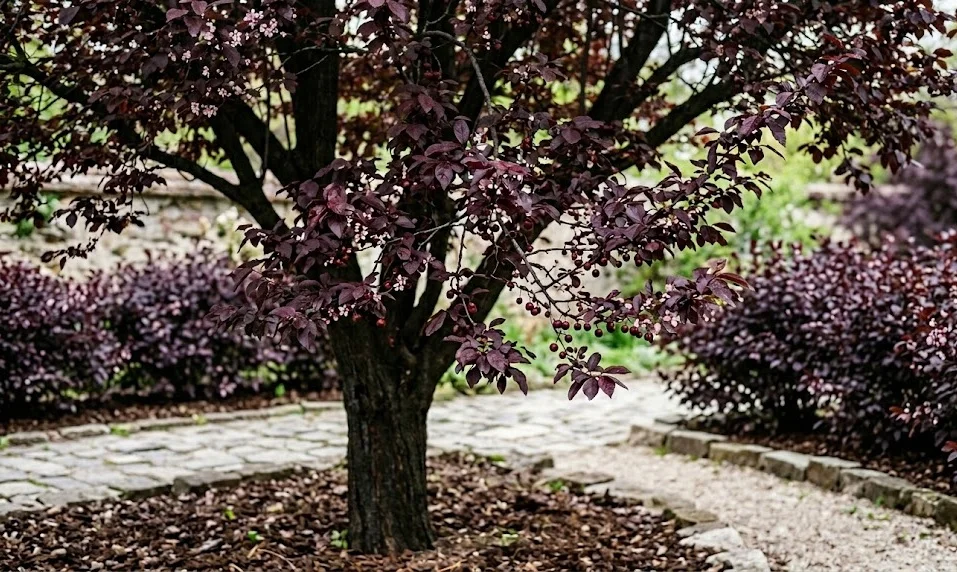

Purple-leaf plum is a rewarding ornamental tree to plant when you want quick visual impact, spring blossom and dramatic foliage in one compact form. Successful establishment begins before the tree goes into the ground, because site selection, soil preparation and planting technique all influence its future health. Propagation is possible, but it requires patience and a clear understanding of how ornamental selections behave. With careful timing and realistic expectations, you can grow strong young trees that settle well into the garden.
Selecting a planting site
A sunny position is the first requirement for a strong purple-leaf plum. The deep leaf colour develops best when the crown receives several hours of direct light each day. In too much shade, the foliage can lose intensity and the tree may flower less freely. A bright position also helps the crown dry more quickly after rain, which can reduce disease pressure.
The site should offer enough space for the tree’s mature spread. Purple-leaf plum is commonly grown as a small ornamental tree, but it still needs room for a rounded crown. Planting too close to walls, paths or larger trees can lead to one-sided growth and future pruning problems. A tree that has space to develop naturally is usually more attractive and easier to maintain.
Soil drainage should be checked before planting. If water remains in the planting area for a long time after heavy rain, the site may need improvement or a different tree may be more suitable. Purple-leaf plum dislikes prolonged waterlogging because roots need oxygen as well as moisture. Slightly raised planting or broader soil improvement can help in marginal sites.
Exposure to wind should also be considered. A young tree can tolerate normal garden conditions, but strong prevailing winds may dry the foliage and loosen the root ball before establishment. In exposed gardens, temporary staking can help while the roots anchor into the soil. The aim is support, not rigid restriction, because a little movement encourages stronger anchorage.
More articles on this topic
Planting technique and early establishment
The planting hole should be wider than the root ball but not excessively deep. The top of the root ball should sit level with the surrounding soil surface. Planting too deeply can cause stress around the trunk base and may lead to poor establishment. Loosening the surrounding soil helps new roots move out into the garden soil.
Before planting, container-grown trees should be watered thoroughly. If roots are circling tightly around the pot, they can be gently teased apart to encourage outward growth. Bare-root trees should be planted while dormant and protected from drying before they go into the ground. In both cases, root health is one of the most important factors in successful establishment.
Backfilling should be done with the excavated soil improved modestly with compost if needed. Over-rich planting pockets can discourage roots from moving beyond the hole. The soil should be firmed gently to remove large air gaps but not compacted heavily. After planting, a thorough watering settles the soil around the roots.
Mulching after planting is highly beneficial. A broad organic mulch layer helps conserve moisture and suppress weeds during the critical first season. It should not touch the trunk, because constant dampness against bark can cause problems. Keeping the base clear also makes it easier to inspect the young tree for damage.
More articles on this topic
Propagation from cuttings and grafted plants
Purple-leaf plum can be propagated from semi-ripe cuttings, although success is not always guaranteed in ordinary garden conditions. Cuttings are usually taken from healthy, non-flowering shoots during the growing season. They need a clean cut, a suitable rooting medium and steady humidity while roots form. Bottom heat and a protected propagation environment can improve results.
The cutting material should come from a healthy tree with good foliage colour and no visible disease. Weak or stressed shoots are less likely to root successfully. Leaves are usually reduced to limit water loss while the cutting has no roots. A rooting hormone may be used to encourage more reliable root formation.
Many ornamental purple-leaf plums sold commercially are grafted or budded onto rootstock. This method gives more uniform trees and can improve vigour or adaptability. A grafted tree may not come true from seed, and seedlings can vary greatly in foliage colour, habit and ornamental quality. For this reason, propagation from seed is usually not the best choice when you want a predictable garden tree.
If shoots appear from below the graft union, they should be removed promptly. These suckers belong to the rootstock and may have green leaves or different growth behaviour. If they are allowed to grow, they can weaken the ornamental crown. Recognising the graft union helps you maintain the desired form of the tree.
Aftercare for young trees
Watering is the most important aftercare task during the first year. The soil should remain evenly moist, especially during dry spells, but it should not become waterlogged. Deep watering once or twice a week in dry weather is usually better than a small amount every day. The exact frequency depends on soil type, rainfall and temperature.
Staking may be needed if the tree is tall, exposed or planted as a bare-root specimen. The stake should hold the root ball steady while still allowing the trunk to move slightly. Ties should be checked regularly because they can tighten as the trunk grows. Once the tree is firmly rooted, the stake should be removed rather than left in place for years.
Pruning after planting should be minimal unless branches are damaged, crossing or badly placed. Young purple-leaf plums establish better when they keep enough foliage to feed the root system. Structural pruning can be done gradually over the following seasons. This approach creates a stronger tree without shocking it.
The planting area should be kept free from aggressive weed and grass competition. Grass growing right up to the trunk can take moisture and nutrients from the young tree. A mulched circle around the base gives the roots a better start. With consistent care during the establishment period, purple-leaf plum usually develops into a vigorous and attractive ornamental tree.