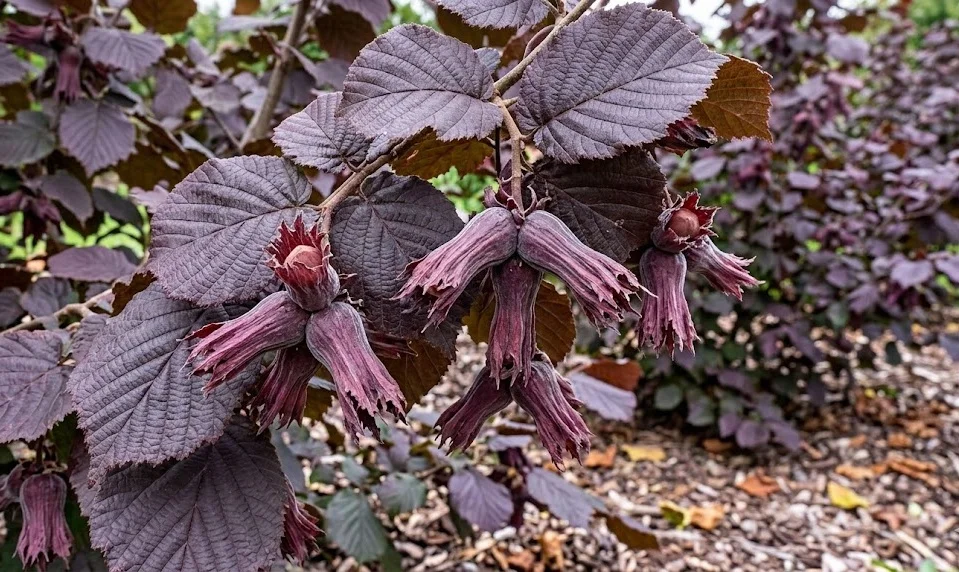

Pruning purple-leaved filbert is a matter of selective renewal, not routine shearing. The shrub naturally forms a broad, layered crown, and its beauty depends on preserving that character while removing weak, old, or misplaced wood. Correct pruning improves light penetration, air circulation, foliage color, and long-term vigor. Poor pruning, especially harsh clipping, can make the plant dense outside and bare inside.
Timing and pruning goals
The best pruning time depends on the goal. Structural work is often done during dormancy, when the branch framework is visible. Light corrective pruning can also be done after flowering if needed. Diseased or broken wood should be removed whenever it is noticed.
The main goal is to maintain a healthy balance of young and mature stems. Young shoots carry strong foliage and help renew the plant. Older stems provide structure but can become crowded or less productive. Gradual renewal keeps the shrub attractive without sudden loss of form.
Pruning should also improve air movement through the canopy. Dense growth traps humidity and favors fungal problems. Removing selected interior branches allows leaves to dry faster after rain. This is especially important in humid climates or sheltered gardens.
Flowering and nut production should be considered before cutting. Removing too much wood can reduce the following crop. The best approach is to prune thoughtfully, taking only what is needed. A well-managed shrub does not need dramatic annual cutting.
More articles on this topic
Practical pruning technique
Start by removing dead, damaged, diseased, or crossing branches. These cuts improve health immediately and clarify the remaining structure. Cuts should be clean and made close to a branch junction or the base of the stem. Stubs should not be left because they die back and invite decay.
Next, identify the oldest stems if the shrub is crowded. One or two older stems can be removed at ground level each year. This encourages new shoots from the base and keeps the plant youthful. Removing all old wood at once is too severe for most ornamental situations.
Branches growing inward or rubbing against others should be thinned. The aim is not to create an empty center, but to reduce congestion. Natural spacing allows light to reach more leaves. This supports stronger color and more even growth.
Tools must be sharp and appropriate for the branch size. Hand pruners are suitable for small stems, while loppers or a pruning saw are better for larger wood. Crushing branches with dull tools damages tissue and slows healing. Cleaning tools is important when disease is suspected.
More articles on this topic
Cutting back neglected or damaged shrubs
A neglected purple-leaved filbert may become tangled, tall, and sparse. Renovation should usually be done over two or three years. Removing about a third of the oldest stems in one season is a safe starting point. This approach preserves enough foliage to feed the roots.
Severe cutting back can be used in special cases, but it carries risks. The plant may respond with many vigorous shoots that need careful selection later. Flowering and ornamental form may be reduced for a season or more. It should not be the default method for a healthy shrub.
Storm-damaged plants need practical pruning rather than cosmetic shaping. Broken branches should be cut back to sound wood. Split stems may need removal if they cannot heal structurally. After damage, the shrub should be watered and mulched well to support recovery.
Green-leaved suckers should be removed immediately if they appear. These shoots may come from rootstock and can overtake the purple cultivar. Cutting them back lightly is not enough because they regrow strongly. They should be removed as close to their origin as possible.