
Planting purple-leaved filbert successfully begins with choosing a site that supports both its ornamental character and its long-term root development. This shrub is not difficult, but it rewards careful soil preparation and correct spacing. Its purple foliage needs light, its roots need oxygen, and its crown needs room to mature naturally. A well-planted specimen establishes faster, colors better, and requires fewer corrections later.
Choosing the right planting site
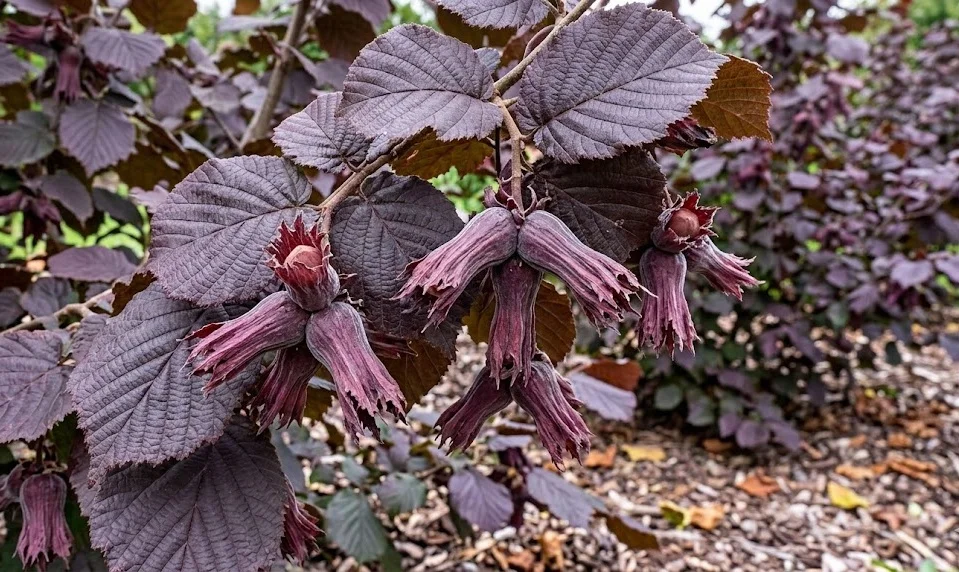
Purple-leaved filbert should be planted where it receives full sun or light partial shade. Stronger light usually produces deeper leaf color and denser growth. In very hot climates, slight afternoon shade can reduce summer stress. Deep shade, however, weakens the plant and reduces its ornamental effect.
The mature size of the shrub must be considered before planting. It can become wide and rounded, so it should not be placed too close to walls, paths, fences, or other shrubs. Crowding leads to poor air movement and more frequent pruning problems. Proper spacing allows the plant to develop its natural form.
Soil drainage is one of the most important site factors. Purple-leaved filbert does not tolerate stagnant water around the roots for long periods. If the chosen area remains wet after rain, drainage improvement is needed before planting. Raised beds or broad mounds can help in difficult soils.
The plant also works well in mixed borders, edible landscapes, and ornamental shrub groups. Its foliage contrasts beautifully with green, silver, and golden plants. Because it is seasonally deciduous, it should be combined with plants that provide winter structure. Good design considers the shrub’s appearance throughout the whole year.
More articles on this topic
Soil preparation and planting technique
Soil should be prepared over a wide area rather than only in a small planting hole. Roots spread outward as they establish, so surrounding soil must be loosened and improved. Compost can be mixed into poor soil to improve structure and biological activity. Very heavy amendments should not create a sharply different pocket that traps water.
The planting hole should be wider than the root ball but not excessively deep. The plant should sit at the same depth it grew in the nursery container or field. Planting too deeply can suffocate roots and encourage collar problems. After placement, soil should be firmed gently to remove large air pockets.
Watering immediately after planting is essential. The first watering settles soil around the roots and reveals whether the plant is positioned correctly. If soil sinks, more soil can be added without burying the stem base. A final mulch layer helps conserve moisture and protects the developing root system.
Staking is usually unnecessary for shrub-form plants unless the site is very windy or the specimen is top-heavy. If support is used, it should be loose enough to allow slight movement. Movement helps the plant build stronger anchoring roots and stems. Stakes should be removed once the plant is stable.
More articles on this topic
Propagation methods and cultivar reliability
Propagation of purple-leaved filbert must preserve the cultivar’s characteristics. Seed propagation is unreliable because seedlings may not show the same purple foliage or growth habit. Seeds also introduce genetic variation, which is useful for breeding but not for maintaining a named ornamental form. For true-to-type plants, vegetative propagation is preferred.
Layering is a practical method for gardeners with access to a healthy parent plant. A low, flexible shoot can be bent to the ground, lightly wounded, and covered with soil while still attached. Over time, roots form at the buried section. Once rooted strongly, the new plant can be separated and transplanted.
Hardwood cuttings can sometimes be used, although results vary. Cuttings are usually taken during dormancy from mature, healthy shoots. They need suitable humidity, drainage, and patience, because rooting may be slow. Professional nurseries often use controlled conditions to improve success rates.
Grafting may also be used in commercial production. When plants are grafted, any shoots emerging from below the graft must be removed. These shoots may belong to the rootstock and may not carry purple leaves. Careful monitoring keeps the ornamental cultivar dominant.
Establishment after planting
The first year after planting should focus on root establishment rather than rapid top growth. Consistent watering is more important than heavy fertilization. Young roots must expand into the surrounding soil before the shrub can perform strongly. Patience during this stage leads to a more resilient plant.
Fertilizer should be used lightly after planting. Too much nitrogen can push soft growth before the roots are ready to support it. Compost and mulch are usually safer than strong mineral feeding. If the soil was prepared well, the young plant often needs very little additional nutrition at first.
Weed control is essential around new plantings. Grass and weeds compete strongly for moisture and nutrients. A clean mulched circle gives the plant a better start. Mulch should be kept away from direct contact with the stems.
Early pruning should be minimal. Only broken, damaged, or badly crossing branches should be removed during establishment. The plant needs leaves to produce energy and build roots. Structural pruning can begin more seriously once the shrub is growing strongly.