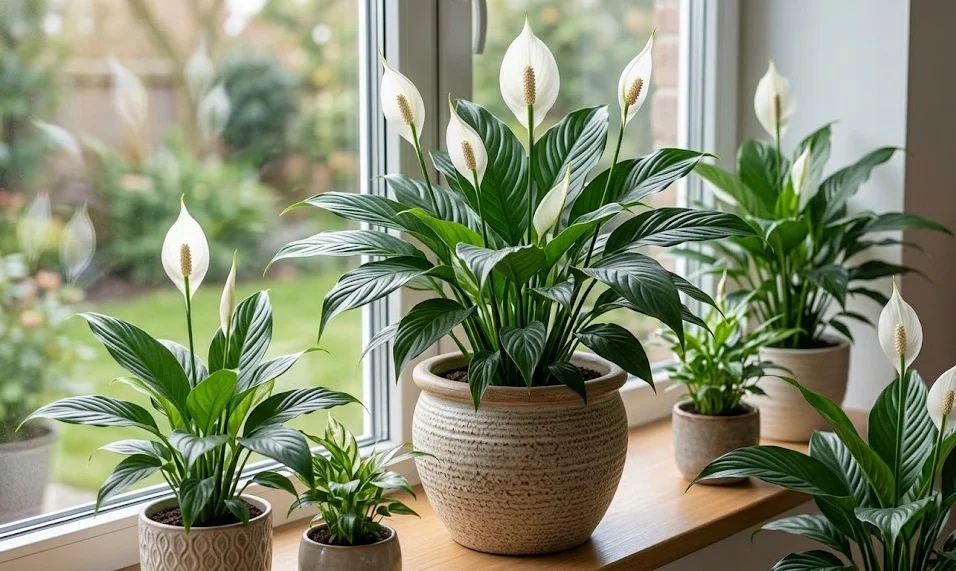

Peace lilies are often marketed as low-light plants, but they perform best in bright indirect light. They can survive in lower light, yet survival is different from vigorous growth and flowering. Light controls leaf size, root activity, bloom production, and overall plant strength. Choosing the right position is one of the most important parts of professional peace lily care.
What bright indirect light means
Bright indirect light means the room is well lit, but direct sun does not strike the leaves intensely for long periods. This condition is common near east-facing windows or behind a sheer curtain in brighter exposures. The plant receives enough energy without the leaf damage caused by harsh sunlight. This is the ideal balance for most indoor peace lilies.
In very dim areas, peace lilies may remain alive for a long time. However, their growth often becomes slow and sparse. Leaves may be smaller, and flowering may stop almost completely. A plant kept far from a window usually needs supplemental light to perform well.
Direct sun is not always equally harmful. Gentle early morning sun may be tolerated, especially in cooler seasons. Strong afternoon sun is much more likely to scorch leaves. The intensity, duration, and season all influence how the plant responds.
A simple test is to observe the shadow near the plant. A soft but visible shadow usually indicates good indirect light. A sharp intense shadow may mean the light is too direct. No clear shadow at all may mean the location is too dark for strong growth.
More articles on this topic
Signs of too little or too much light
A peace lily receiving too little light may produce fewer new leaves. Existing leaves can become darker green but less vigorous. Flowering is often reduced because the plant lacks enough energy to support blooms. Growth may lean toward the nearest window.
Too little light also affects watering. Soil dries more slowly because the plant uses less water. If watering is not adjusted, root rot becomes more likely. Many overwatering problems are actually linked to insufficient light.
Excessive light creates different symptoms. Leaves may develop pale, bleached areas or dry brown patches. Edges can curl or crisp if sun exposure combines with heat and low humidity. The plant may wilt during bright periods even when the soil is moist.
Correcting light problems should be gradual when possible. A plant moved from deep shade directly into a bright window may stress. Shift it closer to better light over several days or use a curtain to soften exposure. Stable adjustment produces better results than sudden change.
More articles on this topic
Using natural and artificial light effectively
East-facing windows are often excellent for peace lilies because morning light is bright but gentle. North-facing windows can work if they are unobstructed and the room is not too dark. South- and west-facing windows may be suitable if the plant is set back or filtered by a curtain. The best position depends on local climate, season, and window size.
Artificial lighting can greatly improve peace lily performance in dark homes or offices. A full-spectrum grow light placed at an appropriate distance can support compact growth. Duration matters as much as brightness, and many indoor plants benefit from a daily light period of roughly ten to twelve hours. The lamp should not heat or scorch the leaves.
Rotate the pot every week or two to keep growth balanced. Peace lilies naturally lean toward the strongest light source. Rotation encourages a more symmetrical shape. It also helps prevent one side from becoming dense while the other weakens.
Light should be evaluated together with watering, temperature, and nutrition. A plant in brighter light usually uses water faster and may grow more actively. A plant in lower light needs less frequent watering and less fertilizer. Matching all care practices to the light level is the foundation of healthy growth.