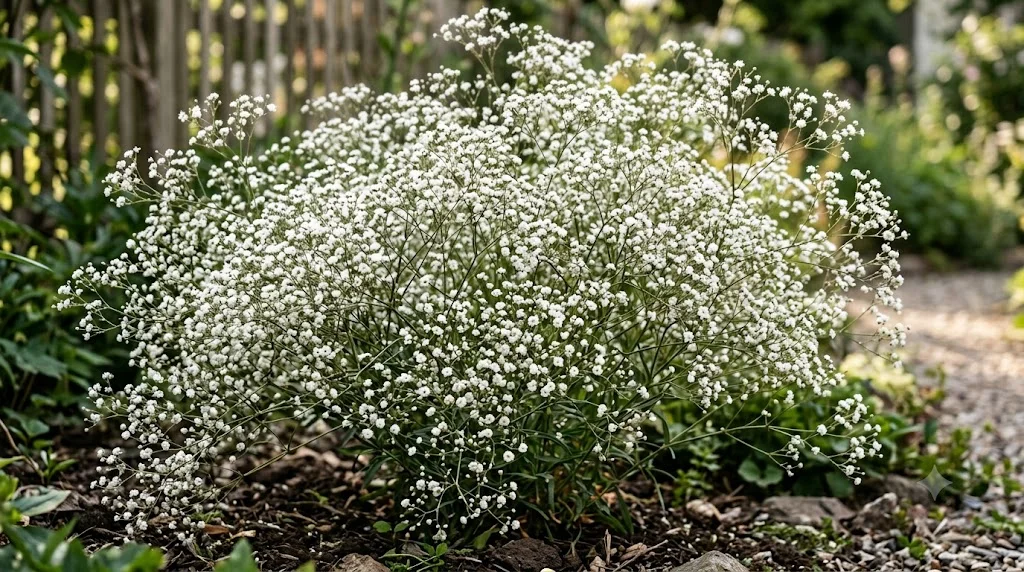

Perennial baby’s breath is naturally capable of surviving cold winters, but its success depends heavily on keeping the crown and taproot dry enough during dormancy. In many gardens, winter moisture causes more damage than frost itself. Preparation should focus on drainage, timely cutting, crown protection, and avoidance of heavy mulch. A properly established plant normally returns from the crown when spring temperatures begin to rise.
Preparing plants in autumn
Allow the plant to complete its flowering cycle before making major autumn cuts. Green stems continue to support the root system after the last flowers fade. Removing all growth too early can reduce the amount of energy stored for winter. Only diseased, broken, or badly collapsed stems need immediate attention.
As the foliage naturally yellows and dries, the plant enters dormancy. Dead stems can be shortened in late autumn or left partially in place until early spring. Retaining some stem framework may help mark the crown and trap a modest amount of insulating snow. In very wet regions, removing collapsed material reduces moisture accumulation around the base.
Autumn is a good time to inspect the crown and surrounding soil level. Soil, compost, or mulch that has shifted against the plant should be pulled back. The crown must remain exposed to air and sit at approximately the original planting depth. Depressions that collect rainwater should be corrected before the ground freezes.
Late fertilization should be avoided because it encourages soft growth that does not harden properly. Irrigation should also be reduced as temperatures fall and natural rainfall increases. Newly planted specimens may still need water during a dry autumn, but saturation must be prevented. Mature plants generally require little supplemental moisture before dormancy.
More articles on this topic
Protecting the crown from winter moisture
A mineral mulch is usually safer than a thick layer of leaves, bark, or compost. Gravel keeps mud away from the crown while allowing water and air to move freely. It also reduces the repeated wetting and drying of surface soil. The layer should remain shallow enough that it does not bury the crown.
In regions with heavy winter rainfall, temporary overhead protection may be useful for exceptionally valuable specimens. A simple transparent cover can deflect direct rain while leaving the sides open for ventilation. It must not create a warm, sealed enclosure around the plant. Trapped condensation can be as harmful as rainfall.
Snow is generally less dangerous than cold rain because it can insulate the dormant crown. Problems arise when snow melts repeatedly into poorly drained ground and then refreezes. Good subsurface drainage allows meltwater to leave the root zone. Ice that remains around the crown for long periods may damage tissues.
Avoid wrapping the crown tightly in plastic, impermeable fabric, or dense insulation. Such coverings trap moisture and restrict air exchange. Protection should moderate exposure without sealing the plant. Dryness and ventilation remain the priorities throughout winter.
More articles on this topic
Overwintering young and container-grown plants
First-year plants are more vulnerable because their root systems are not yet fully developed. Spring planting gives them the longest possible establishment period before winter. A newly planted specimen should enter dormancy in firm contact with the surrounding soil but without being deeply buried. Root heaving can be reduced by maintaining stable surface conditions.
A light, airy covering of dry material may be used in extremely cold areas after the ground has frozen. The covering should not remain wet or compact around the crown. Evergreen branches can provide gentle shading and reduce rapid temperature fluctuations while allowing ventilation. They should be removed gradually as winter ends.
Container-grown perennial baby’s breath needs more protection because roots in pots experience stronger temperature changes than roots in open ground. The container should be tall, frost-resistant, and freely drained. It can be moved against a sheltered wall or placed in an unheated, ventilated structure. The compost should remain barely moist rather than completely dry or saturated.
Pots should not stand in saucers filled with rainwater during winter. Raising the container on feet helps drainage openings remain clear. Wrapping the outside of the pot can reduce root freezing, but the plant crown should remain uncovered and ventilated. Containers should be checked occasionally because protected compost may dry more than expected.
Spring recovery and frost management
New growth usually emerges from the crown as the soil warms. The exact timing varies with climate, exposure, and cultivar, so a dormant plant should not be discarded too early. Healthy crown tissue remains firm even when no shoots are visible. Soft, dark, or foul-smelling tissue indicates likely winter decay.
Remove winter protection gradually to prevent sudden exposure of tender shoots. Dry leaves and old stems can be cleared once growth becomes visible. Cutting tools should be used carefully because young shoots are easily damaged. A clean crown improves air circulation and makes emerging pests easier to detect.
Late frost can injure fresh growth even though the dormant root system is hardy. A breathable horticultural fleece may be placed loosely over the plant on cold nights. The cover should be removed during the day so the shoots receive light and ventilation. Heavy materials can crush the brittle new stems.
Spring feeding should begin only after active growth is established. A light application of balanced fertilizer or mature compost is sufficient in most soils. Watering should remain cautious because cool ground dries slowly. The plant will resume stronger growth as temperature, sunlight, and root activity increase together.