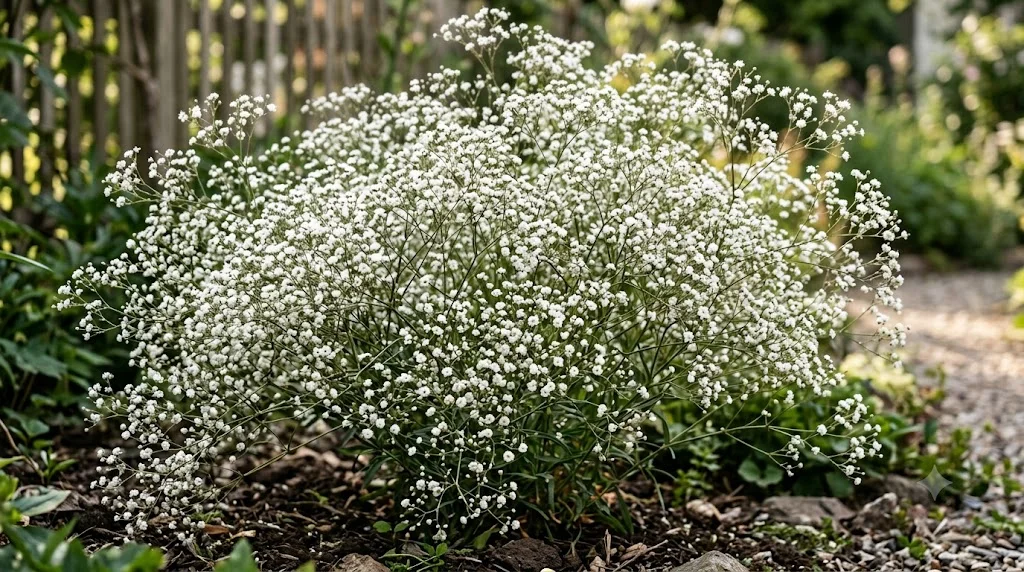

Perennial baby’s breath produces its strongest stems and most abundant flowers when grown in full, direct sunlight. Light influences not only bloom quantity but also plant shape, stem strength, drying speed, and resistance to disease. A site that appears bright may still provide too few hours of direct sun if it is shaded by buildings or trees for much of the day. Careful observation of seasonal light patterns helps identify a position in which the plant can develop its characteristic open cloud of flowers.
The value of full sun
A minimum of about six hours of direct sunlight is generally needed for satisfactory flowering. Plants receiving eight or more hours often develop denser branching and a more balanced outline. Strong light supports efficient photosynthesis and the formation of numerous flower buds. It also helps stems remain shorter, firmer, and better able to support the bloom mass.
Morning and midday sunlight are especially valuable because they dry dew and rain from the fine branches. Rapid drying reduces the duration of humid conditions around the foliage and crown. This contributes to lower disease pressure. An open, sunny site is therefore beneficial in several connected ways.
In cooler climates, full-day exposure is usually ideal. Heat buildup is rarely a problem when the soil is well drained and the roots are established. Pale mineral mulch can reflect additional light into the lower canopy. The plant’s narrow foliage is naturally adapted to bright, relatively dry conditions.
Sunlight also affects the timing and duration of flowering. Shaded plants may open later, produce fewer blooms, and remain green at the expense of flowering. The display can appear sparse rather than mist-like. Increasing fertilizer does not correct a lack of light and may make the stems weaker.
More articles on this topic
Recognizing and managing insufficient light
The most obvious symptom of inadequate light is elongated, leaning growth. Stems stretch toward the brightest direction and may become widely spaced or unstable. Flowering branches are fewer, and the center of the plant can look open. Lower foliage may yellow earlier because it receives little usable light.
Partial shade from deciduous trees can be misleading in early spring. A position may appear sunny before the tree canopy expands, then become deeply shaded as the baby’s breath approaches flowering. Observe the site during late spring and summer rather than relying only on winter conditions. Shadows from buildings also change as the sun’s angle shifts through the season.
Light competition from nearby perennials can produce similar effects. Tall, dense companions may surround the plant even when the border itself receives full sun. Adequate spacing allows light to reach the crown and lower branches. Plants should be arranged according to mature height and spread rather than their size at planting.
A young plant can sometimes be moved to a sunnier position before its taproot becomes deeply established. Mature specimens are much more difficult to transplant successfully. If a large plant is already shaded, reducing nearby competition may be safer than relocating it. Propagating a replacement for a better site is often the most reliable long-term solution.
More articles on this topic
Balancing sunlight with heat and exposure
In very hot climates, intense afternoon sun may combine with dry wind to increase water loss. Established plants usually tolerate this exposure, but recently planted specimens need closer moisture monitoring. Light afternoon shade may be acceptable where summers are extreme, provided the plant still receives several hours of direct sun. Dense shade should still be avoided.
A south-facing wall can create a particularly warm and dry microclimate. This may encourage early growth and rapid flowering, but it can also increase the effect of late frost or drought. Sufficient distance from the wall improves air movement. The planting soil should be deep enough to support stable root moisture.
Reflected light from pale paving or stone can benefit flowering while also raising local temperature. Plants beside hard surfaces may need additional water during establishment. They should be positioned where rainwater does not run repeatedly toward the crown. The combination of high light and good drainage is valuable only when extreme heat is managed sensibly.
Wind exposure often accompanies open, sunny sites. Strong light produces sturdy stems, but mature flowering plants may still require discreet support in storm-prone areas. A position with sun and moderate shelter is ideal. The shelter should remain open enough to preserve air circulation and prevent humidity from becoming trapped.