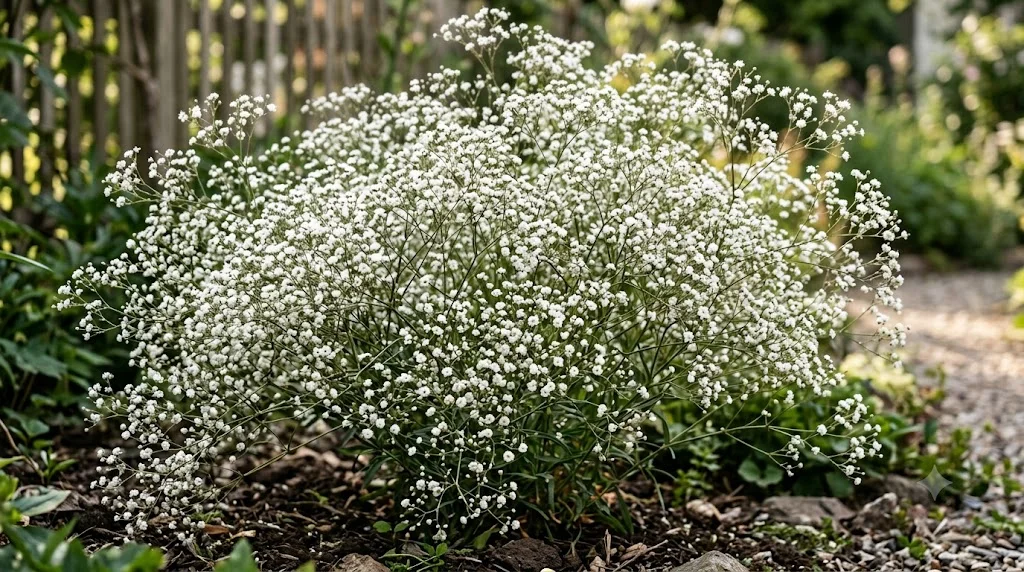

Planting perennial baby’s breath is a long-term decision because the plant develops a deep taproot and performs best when left undisturbed. Careful site preparation is therefore more important than rapid planting or frequent transplanting. Propagation is possible through seed, cuttings, and specialized nursery techniques, although each method produces different levels of uniformity. A good start allows the young plant to establish a durable crown capable of supporting years of summer flowering.
Preparing the planting site
Choose a permanent location with full sun, excellent drainage, and enough width for the mature plant. The soil should be loosened deeply so that the developing taproot can penetrate without encountering a compacted layer. Stones that block vertical root growth can be removed, while coarse mineral material may be retained when it improves drainage. The prepared area should be wider than the nursery container even though the root ball itself may be relatively small.
Heavy soil requires structural improvement rather than the simple addition of a thin layer of sand. Mixing small quantities of sand into dense clay can sometimes produce an even more compact texture. Coarse grit, fine gravel, and well-decomposed organic matter should be incorporated through a broad area. In persistently wet gardens, a raised planting mound may be the safest solution.
Check the soil reaction before applying lime or other amendments. Perennial baby’s breath prefers neutral to alkaline conditions, but unnecessary liming can disturb nutrient availability. A soil test provides a more reliable basis for amendment than assumptions based on appearance. Any lime should be mixed into the soil well before planting rather than concentrated directly around the root ball.
Remove perennial weeds thoroughly because digging them out later may damage the established taproot. Bindweed, couch grass, and similar invasive weeds are particularly difficult to control beneath mature branching stems. The site can be prepared several weeks in advance so newly emerging weeds can be removed before planting. This reduces competition during the critical establishment period.
More articles on this topic
Planting container-grown specimens
Spring is usually the safest planting period in regions with cold or wet winters. The young plant then has an entire growing season to form roots before winter dormancy. Early autumn planting can work in mild, dry climates where the soil remains warm but does not become waterlogged. Late planting into cold, saturated ground should be avoided.
Water the nursery container before planting so the root ball holds together during removal. Handle the root system gently and do not break apart the fleshy roots in the way that might be suitable for fibrous-rooted perennials. If roots circle tightly around the pot, only the outermost congested sections should be eased carefully. Severe root disturbance can delay establishment or cause the plant to fail.
Set the plant so that the crown remains level with the surrounding soil surface. Planting too deeply encourages moisture to collect around the crown, while planting too high exposes the upper root system. Backfill gradually and firm the soil with the hands rather than compacting it heavily with a boot. Water thoroughly once to settle the soil and remove large air pockets.
Allow generous spacing between plants, particularly when using tall traditional cultivars. A mature specimen may occupy far more space than its appearance in a small nursery pot suggests. Crowded planting restricts air circulation and creates competition for light. It can also make future pruning and inspection of the crown unnecessarily difficult.
More articles on this topic
Raising plants from seed
Seed propagation is economical and useful for producing single-flowered plants in quantity. Seeds can be sown in spring in a light, free-draining medium and covered only lightly. Consistent moisture is needed during germination, but the medium should never become saturated. Warm, bright conditions generally support even emergence.
Seedlings should receive strong light as soon as they emerge to prevent weak, elongated growth. Air circulation is also important because densely sown seedlings are vulnerable to damping-off. Watering from below can help keep the stem bases and foliage drier. Any diseased or collapsed seedlings should be removed immediately.
Transplant seedlings while they are still young and the taproot is manageable. Delaying too long allows the root to lengthen and increases the risk of breakage. Deep individual pots or root-training containers are preferable to shallow trays. Each seedling should be handled by its leaves rather than squeezed by the tender stem.
Seed-grown plants are not guaranteed to reproduce the exact qualities of a named cultivar. Flower fullness, height, branching pattern, and bloom timing may vary among seedlings. This variation can be desirable in naturalistic gardens but unsuitable when uniform cut-flower production is required. Named double-flowered cultivars are normally propagated vegetatively to preserve their characteristics.
Propagating named plants and caring for young stock
Vegetative propagation can be attempted with basal or soft stem cuttings taken from healthy, non-flowering growth. The cuttings should be prepared with clean tools and inserted into a sterile, sharply drained propagation medium. High humidity helps prevent wilting, but stagnant, saturated conditions encourage decay. Gentle bottom warmth may improve rooting consistency.
Cuttings should be taken from vigorous stock plants that show no signs of crown rot, virus-like distortion, or pest damage. Weak material rarely produces strong young plants. Rooting hormone may improve results, particularly with cultivars that are reluctant to root. Even under controlled conditions, success can be less predictable than with many common border perennials.
Commercial growers may use grafting or tissue-culture methods for valuable double-flowered cultivars. These techniques maintain uniformity and allow large numbers of identical plants to be produced. Grafted plants require careful handling because the union must remain healthy and correctly positioned. Home gardeners usually obtain more reliable results by purchasing professionally propagated named plants.
Newly rooted cuttings and young seedlings should be hardened gradually before planting outdoors. Sudden exposure to intense sun, cold nights, or drying wind can damage tender growth. Increase ventilation and outdoor exposure over several days while slightly reducing protected humidity. Once planted, maintain moderate moisture until the roots begin exploring the surrounding soil.