
The emergence of Stemphylium fruit rot, caused by the fungal pathogen Stemphylium ilicis, presents a significant and growing challenge for commercial apple growers worldwide. This disease primarily affects the fruit, leading to visible quality degradation and severe economic losses if left unmanaged during the production cycle. Understanding the subtle biology and survival mechanisms of this pathogen is essential for implementing timely and targeted control strategies in the orchard. Producers must transition from reactive spraying to proactive management to safeguard both current yields and long-term storage viability.
The fungal pathogen classified as Stemphylium ilicis thrives in temperate production zones where humidity fluctuations create favorable microclimates. It overwinters primarily as mycelium or saprophytic structures within fallen leaves, organic debris, and mummified fruits left on the orchard floor. When spring temperatures rise, these overwintered reservoirs produce primary conidia that are easily disseminated by wind currents and water splashing. This initial movement of spores marks the beginning of the seasonal infection cycle, targeting vulnerable new growth and early fruit developments.
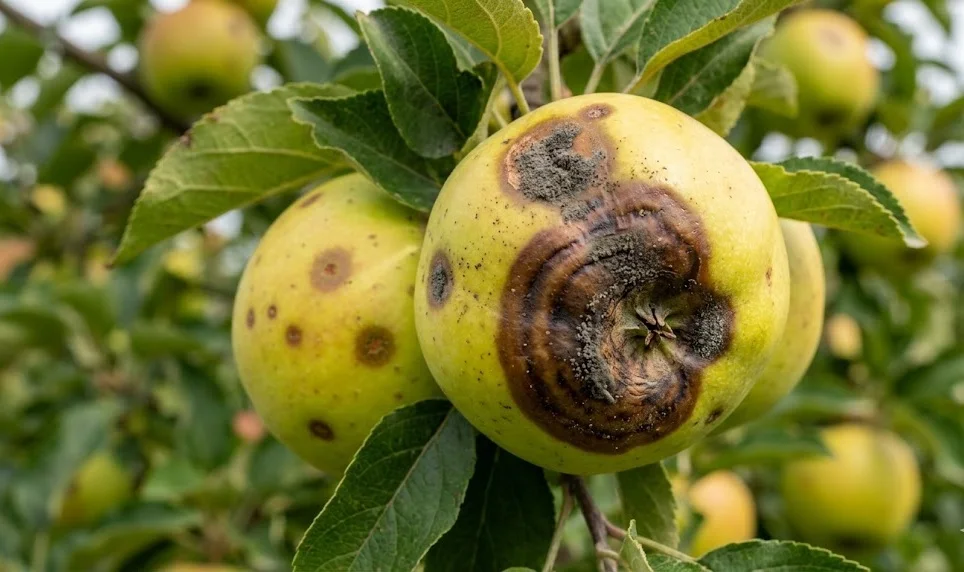
Visual identification of the disease in the field requires a sharp eye, as early symptoms can easily be mistaken for other common fungal infections. The rot typically manifests as small, circular, dark brown to black spots that develop around the lenticels or the calyx end of the maturing apple. As the infection progresses, these lesions become slightly sunken and the underlying flesh undergoes a dry, spongy decay. Unlike some rapid soft rots, this condition advances steadily, eventually compromising the structural integrity of the entire fruit matrix.
The economic consequences of an uncontrolled outbreak extend far beyond the immediate field losses observed during harvest. Latent infections present a hidden danger, as seemingly pristine fruit can harbor the dormant fungus throughout the picking process. Once these apples are placed into cold storage facilities, the pathogen often reactivates, causing widespread rot that can ruin entire batches of stored inventory. Consequently, establishing an integrated management framework is critical to protecting grower profitability and ensuring market access.
Environmental drivers and disease kinetics
Microclimatic factors within the orchard canopy dictate the speed and success of Stemphylium ilicis infections during the growing season. Prolonged periods of leaf and fruit wetness, typically exceeding twelve continuous hours, provide the ideal environment for spore germination. Relative humidity levels remaining above eighty-five percent further accelerate the expansion of fungal germ tubes into plant tissues. Orchard managers must closely monitor weather forecasts to anticipate these high-risk windows and apply protective measures accordingly.
Temperature plays an equally vital role in modulating the aggressive nature of this specific fruit rot pathogen. Optimal mycelial growth and spore production occur within a moderate range of fifteen to twenty-five degrees Celsius. When these temperature parameters coincide with frequent rainfall events, the disease pressure escalates exponentially across susceptible apple cultivars. Understanding this correlation allows agronomic advisors to build accurate predictive models that take the guesswork out of treatment timing.
Canopy architecture directly influences the duration of moisture retention, acting as an internal driver of disease severity. Densely planted orchards with unpruned, thick tree centers trap humid air and prevent sunlight from reaching the inner branches. This lack of airflow creates persistent pockets of moisture that shield the fungus from natural drying effects. Consequently, addressing tree structure becomes a fundamental requirement for disrupting the ideal conditions the pathogen requires to thrive.
Topographical variations across the agricultural land also contribute to uneven disease distribution and localized hot spots. Low-lying orchard blocks or areas adjacent to dense windbreaks often suffer from poor air drainage, extending the dew periods significantly. Mapping these vulnerable zones helps growers apply variable-rate management strategies, focusing intense scrutiny where the risks are highest. This targeted approach optimizes resource allocation while maintaining robust protection across the entire farming operation.
Cultural practices and orchard hygiene
Eliminating the primary inoculum source is the most effective way to break the life cycle of Stemphylium ilicis before it reaches the fruit. Orchard sanitation should begin immediately after harvest by managing the floor environment where the fungus intends to overwinter. Flail mowing or shredding fallen leaves in late autumn breaks down organic material, accelerating natural decomposition processes. This mechanical disruption leaves the pathogen without a stable substrate to survive the harsh winter conditions.
Applying a low concentration of urea to the orchard floor during late leaf drop further stimulates beneficial microbial activity. This nitrogen boost encourages earthworms and native saprophytic bacteria to consume the leaf litter rapidly, outcompeting the target pathogen. Reducing the spore load on the ground directly correlates with lower infection rates during the subsequent spring flowering period. Cultivating a clean floor environment creates a sanitary foundation that enhances all subsequent plant protection efforts.
Pruning during the dormant season serves a dual purpose by shaping the tree and removing existing disease reservoirs. Workers must carefully identify and remove dead wood, old cankers, and any remaining mummified fruits from the branches. These structures often harbor high concentrations of fungal spores that can easily wash down onto young fruit later in the year. Sterilizing pruning tools between rows prevents the inadvertent mechanical transmission of pathogens across different blocks.
Regular vegetation management under the tree row helps maintain lower relative humidity levels within the lower canopy zone. Tall weeds and dense cover crops directly beneath the branches act as moisture traps, hindering efficient air movement. Keeping the under-tree strip clean or closely mown allows air to circulate freely, promoting rapid drying after rain events. This simple adjustment to floor management significantly reduces the window of opportunity for fungal spore germination.
Nutritional strategies for fruit resistance
The physiological capacity of an apple to resist fungal invasion depends heavily on the nutritional balance of the tree. Developing robust cell walls serves as the primary physical barrier against the enzymatic penetration attempted by Stemphylium ilicis. Balanced fertilization programs must prioritize structural integrity over excessive vegetative growth to ensure long-term fruit health. Over-fertilizing with nitrogen must be avoided, as it leads to large, watery cells that are easily breached by fungal hyphae.
Calcium plays a paramount role in reinforcing the middle lamella of plant cell walls, rendering them resistant to fungal degradation. Since calcium moves passively through the plant via transpiration, it often fails to reach the developing fruit in sufficient quantities. Implementing a consistent schedule of foliar calcium sprays during the summer ensures direct absorption into the fruit peel. This targeted supplementation significantly enhances the fruit’s mechanical resistance to post-harvest decay and field infections.
Potassium and magnesium levels must be carefully balanced against calcium to avoid induced deficiencies in the fruit tissue. High concentrations of potassium in the soil can antagonize calcium uptake, leading to structural weaknesses despite adequate overall calcium availability. Regular leaf and fruit analysis should be utilized to track these nutrient ratios dynamically throughout the season. Adjusting fertilizer inputs based on precise diagnostic data prevents nutritional imbalances that predispose the crop to rot.
Emerging research indicates that micronutrients such as silicon and boron also contribute to systemic plant defense mechanisms. Silicon accumulation in the epidermal layers creates an additional inorganic barrier that blunts fungal penetration mechanisms. Boron facilitates proper cell division and assists in the efficient utilization of calcium within the growing fruit matrix. Integrating these micronutrients into standard nutritional programs builds a multi-layered defense system from the inside out.
Chemical management and resistance mitigation
When environmental conditions favor high disease pressure, synthetic fungicides become necessary components of an integrated management plan. Timing these applications correctly is critical, with the most vital windows occurring during late summer as the fruit matures. Protective fungicides should ideally be applied before anticipated rain events to establish a chemical barrier on the fruit surface. This preventative approach ensures that arriving spores encounter a lethal dose of the active ingredient before they can infect.
Selecting the right active ingredients requires a deep understanding of fungicide classes and their specific modes of action. Broad-spectrum protectants, such as captan or mancozeb, serve as excellent foundation products due to their multi-site activity. Systemic options, including succinate dehydrogenase inhibitors and triazoles, provide curative action against early latent infections within the tissue. Combining these different chemical families ensures comprehensive coverage and maximizes the overall efficacy of the spray program.
Resistance management is a paramount consideration when dealing with single-site systemic fungicides like strobilurins. Stemphylium species possess a high capacity for genetic adaptation, making them prone to developing resistance if exposed repeatedly to the same chemical class. To mitigate this risk, growers must strictly limit the number of consecutive applications of any single mode of action. Alternating or tank-mixing single-site fungicides with multi-site protectants disrupts the selection pressure, preserving chemical efficacy for future seasons.
Adhering to strict pre-harvest intervals is essential to comply with international pesticide residue limits and protect consumer health. Late-season applications must balance the need for fruit protection with the legal requirements of the target market. Calibrating application equipment regularly ensures uniform droplet distribution throughout the entire tree canopy, reducing chemical waste. Accurate record-keeping of every application allows for traceability and continuous refinement of the orchard’s chemical strategy.
Biological alternatives and integrated approaches
The global shift toward sustainable agriculture has driven significant interest in biological control alternatives for managing fruit rots. Beneficial microorganisms offer a non-toxic method to suppress Stemphylium ilicis populations on the fruit surface. These biological agents operate through competitive exclusion, occupying the space and consuming nutrients that the pathogen requires to establish itself. Introducing these natural competitors creates a dynamic shield that reduces reliance on conventional synthetic chemistry.
Strains of Bacillus subtilis and Trichoderma species have demonstrated strong antagonistic activity against various post-harvest decay fungi. These beneficial organisms produce secondary metabolites that actively disrupt fungal cell membranes and inhibit spore germination. Applying bio-fungicides during the final weeks before harvest provides an effective safety net without leaving chemical residues. This attribute makes biological controls particularly valuable for producers targeting strict zero-residue markets.
Natural plant extracts and essential oils are also being incorporated into modern integrated pest management frameworks. Formulations containing neem oil, thyme extracts, or chitosan have shown promising results in suppressing mycelial growth under field conditions. These natural compounds often stimulate the host plant’s own systemic acquired resistance, priming its internal defenses against future attacks. However, because these products break down rapidly under ultraviolet light, precision in application timing is absolutely critical.
Combining biological agents with cultural sanitation creates a powerful synergy that enhances the overall resilience of the orchard ecosystem. For instance, applying a specialized microbial cocktail to the shredded leaf litter in autumn accelerates decomposition while consuming the overwintering structures. This holistic approach addresses the disease from multiple angles, preventing the pathogen from gaining an upper hand. Sustainable production requires viewing plant protection as a continuous ecological balance rather than an intermittent chemical battle.
Post-harvest handling and storage preservation
The battle against Stemphylium fruit rot does not end when the apples are detached from the tree branches. Careful harvesting techniques are essential to minimize skin punctures, bruising, and mechanical wounds that serve as ideal entry points for spores. Training picking crews to handle the fruit gently significantly reduces the incidence of wound-associated infections during subsequent handling phases. Sorting out visibly damaged or inferior fruit right in the field prevents contaminated items from entering the storage facility.
Rapid cooling immediately after harvest is a vital step in preserving fruit quality and arresting fungal development. Lowering the internal temperature of the apples to near-zero degrees Celsius dramatically slows down the metabolic rates of both the fruit and any latent pathogens. This thermal management holds Stemphylium ilicis in a state of suspended animation, delaying the expression of latent field infections. Maintaining a strict cold chain from the orchard to the packing house is non-negotiable for long-term storage success.
Controlled atmosphere storage facilities utilize precise gas regulation to further suppress the progression of post-harvest decay. Maintaining oxygen levels below two percent and elevating carbon dioxide concentrations inhibits the respiration of fungal organisms. This altered environment extends the storage life of the apples while preserving flesh firmness and acidity levels over many months. Regular calibration of gas sensors and temperature probes is required to prevent physiological disorders caused by atmospheric imbalances.
Rigorous sanitation of the entire storage infrastructure is essential to eliminate residual inoculum from previous packing seasons. Wooden bins, plastic crates, and sorting conveyor belts must be thoroughly cleaned and disinfected with food-safe sanitizing agents. Fungal spores can persist in microscopic cracks and surfaces, ready to inoculate fresh fruit as it passes through the line. Implementing these comprehensive hygiene protocols protects the grower’s financial investment up to the final moment of wholesale distribution.