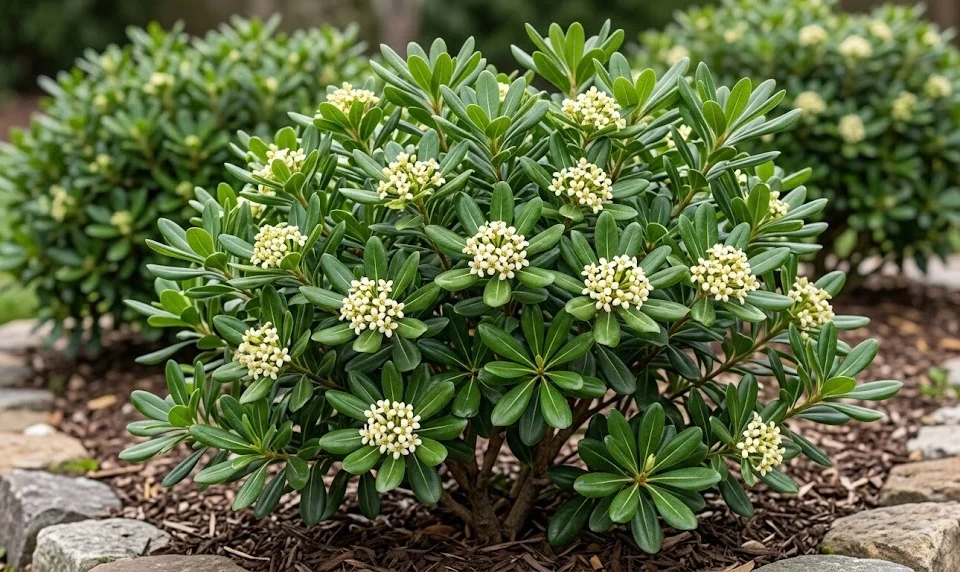

Pruning is an essential aspect of Japanese cheesewood care, as it helps maintain the plant’s health, vigor, and aesthetic form. Because this shrub is a moderate grower, it does not require constant attention, but a well-timed annual trim will keep it from becoming unkempt. The best time for general maintenance pruning is in the late spring or early summer, immediately after the fragrant flowers have finished blooming. This allows you to enjoy the full floral display while giving the plant plenty of time to recover before the winter dormancy begins.
The first step in any pruning session is to remove the “three Ds”: dead, damaged, or diseased wood. This not only improves the appearance of the shrub but also prevents pathogens from spreading to healthy parts of the plant. Use sharp, clean bypass pruners to make clean cuts just above a healthy bud or where the branch joins a larger stem. Removing these problematic branches early in the season opens up the canopy for better light and air penetration, which is vital for long-term health.
Thinning out the interior of the shrub is another important maintenance task that should be performed every few years. Dense growth in the center of the plant can lead to a lack of airflow and light, which often results in the inner leaves turning yellow and falling off. By selectively removing some of the older, more crowded branches, you encourage new growth from the base and keep the interior of the shrub active and green. This “renewal” pruning ensures that the plant doesn’t become a hollow shell of foliage with only a thin layer of leaves on the outside.
For those using Japanese cheesewood as a formal hedge, more frequent light trimming may be necessary to maintain a sharp, clean silhouette. You can use hedge shears or even electric trimmers for this task, but be careful not to cut too deeply into the old wood. Constant shearing can lead to a very thick outer layer of foliage that eventually chokes out the inner branches, so occasional hand-thinning is still required. Maintaining a slightly wider base than the top of the hedge ensures that light can reach the lower branches, preventing them from becoming bare over time.
Shaping and aesthetic training
The Japanese cheesewood is naturally rounded in habit, but it can be easily trained into a variety of shapes to suit your garden’s style. For a more informal look, you can use “heading back” cuts to shorten individual branches and maintain a soft, naturalistic mound. This involves cutting back each stem to a different length, which prevents the “meatball” look that comes from uniform shearing. This approach is perfect for cottage gardens or woodland settings where a more relaxed aesthetic is desired.
More articles on this topic
If you prefer a more structured look, this species is an excellent candidate for topiary or formal geometric shapes like globes or cubes. Its small, dense leaves respond well to frequent light trimming, allowing you to create very precise forms that hold their shape for several months. When training a young plant into a specific shape, it is best to start early and be patient, guided by a simple frame or string line. Small, frequent adjustments are much better for the plant’s health than one massive, stressful pruning session once a year.
One of the most elegant ways to train a Japanese cheesewood is as a multi-stemmed small tree, often referred to as “limbing up.” This involves removing the lower branches to expose the attractive, grayish-brown bark of the main stems and create space for underplanting. This technique is particularly effective for specimens that have become too large for their space or for creating a focal point in a small courtyard. By carefully selecting which branches to remove, you can create a sculptural form that adds a sense of maturity and architectural interest to the garden.
Regardless of the shape you choose, always step back frequently during the pruning process to evaluate your progress from a distance. It is easy to get caught up in the details and end up with an asymmetrical plant if you don’t keep the overall form in mind. Remember that you can always take more off later, but you can’t put a branch back once it has been cut. Developing an eye for the plant’s natural grace will help you prune in a way that enhances its beauty rather than fighting against its natural tendencies.
Rejuvenation and heavy cutting back
Sometimes an old Japanese cheesewood can become overgrown, leggy, or sparse, requiring a more drastic approach to pruning known as rejuvenation. This involves cutting the entire shrub back significantly, sometimes to within a foot or two of the ground, to stimulate a fresh flush of growth from the base. While this can be a shocking sight at first, the species is remarkably resilient and will usually bounce back with vigor within a single growing season. This is best done in the early spring, just as the sap begins to rise but before the new leaves emerge.
More articles on this topic
Before committing to a total rejuvenation, ensure that the plant is healthy and has a strong root system to support the sudden loss of foliage. If the shrub is already struggling due to disease or poor soil, a hard pruning might be the final blow that kills it. In such cases, a more gradual approach over three years—removing one-third of the oldest branches each year—is a safer and less stressful alternative. This “staged rejuvenation” allows the plant to maintain some photosynthetic capacity while it slowly replaces its old structure with new, healthy wood.
After a heavy cutting back, the plant will need extra care to ensure it recovers successfully and grows into a beautiful new form. Provide a balanced fertilizer and keep the soil consistently moist to give the roots the resources they need to produce a massive amount of new foliage. You will likely see a profusion of “water sprouts” or very fast-growing vertical stems, which will need to be thinned out and shaped as they mature. This is the perfect time to steer the plant’s future growth and correct any structural issues that were present in the old specimen.
In conclusion, pruning the Japanese cheesewood is a rewarding task that allows you to play an active role in the beauty of your garden. Whether you are performing simple maintenance, shaping a formal hedge, or rejuvenating an old favorite, the key is to be thoughtful and deliberate with your cuts. By understanding the plant’s growth habits and responding to its needs, you ensure that it remains a healthy and vibrant feature of your landscape. With a pair of sharp shears and a bit of confidence, you can keep your cheesewood looking its best for decades to come.