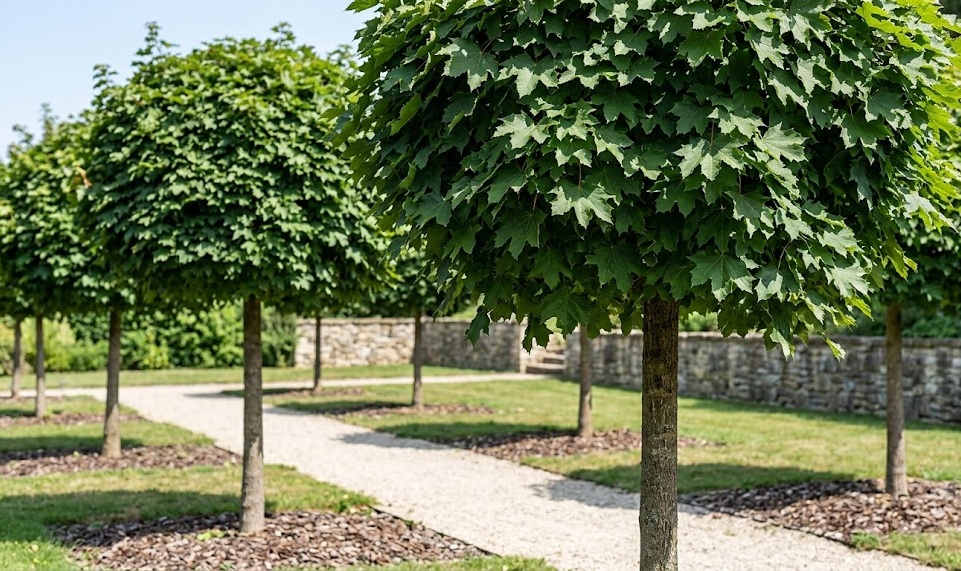

Pruning the Norway maple ‘Globosum’ is a specialized task that focuses on maintaining its natural spherical shape while ensuring its long-term health and structural safety. Unlike many other maples that are allowed to grow into large, sprawling trees, this cultivar is valued specifically for its compact and predictable form. You must approach pruning with a clear plan, using the correct tools and timing to achieve the best results without stressing the tree. A professional pruning job is often invisible; it enhances the tree’s natural beauty without leaving behind obvious scars or awkward growth patterns. Consistency and precision are the keys to success when working with this unique variety.
The timing of your pruning activities is one of the most important factors in the care of the ‘Globosum’ maple. The best time to prune is during the late winter or very early spring while the tree is still dormant but the coldest weather has passed. Pruning during this window minimizes sap loss and allows the tree to begin healing the wounds as soon as the growing season starts. You should avoid pruning in the late spring or early summer when the sap is flowing most heavily, as this can lead to excessive bleeding and attract unwanted pests.
Sanitary pruning can and should be done at any time of the year if you identify dead, diseased, or broken branches. Removing these problem areas promptly prevents the spread of decay and reduces the risk of further damage to the healthy parts of the tree. You should always use sharp, sterilized bypass pruners or a small pruning saw to ensure clean cuts that the tree can easily seal. Leaving a ragged edge or a long stub can lead to infections that might eventually compromise the entire branch or even the trunk.
The primary goal of pruning a mature ‘Globosum’ is to maintain its density and roundness without letting it become too overgrown. Because it is a slow-growing tree, you rarely need to remove large amounts of wood at one time. Instead, a series of small, strategic cuts will keep the sphere looking perfect year after year. You should step back frequently during the process to view the tree from all angles, ensuring that you are maintaining a balanced and symmetrical shape.
Maintaining the spherical shape
The Norway maple ‘Globosum’ naturally grows into a round form, but it can occasionally develop “stray” branches that grow faster than the rest of the canopy. These vigorous shoots can break the clean line of the sphere and should be headed back to match the surrounding foliage. You should cut these branches back to a healthy bud that is facing in the direction you want the new growth to go. This type of corrective pruning is essential for keeping the tree looking its best in formal or architectural settings.
More articles on this topic
Thinning the interior of the crown is another important aspect of maintaining the spherical shape over the long term. Because the outer foliage is so dense, the inner branches often become shaded and eventually die, creating a “shell” of growth. By selectively removing some of the smaller, crossing, or weak branches from the inside, you allow more light and air to reach the center. This keeps the internal structure healthy and prevents the tree from becoming a target for fungal diseases that thrive in stagnant air.
Crown reduction is sometimes necessary if the ‘Globosum’ has grown too large for its allotted space or if the graft union is under too much stress. This should be done carefully by cutting back the longest branches to a strong lateral branch that can take over as the new lead. You should never “top” the tree by cutting all the branches at the same height, as this leads to a flush of weak, unattractive growth. A professional reduction preserves the natural look of the tree while effectively managing its total volume.
Final checks after a pruning session should include an inspection of all the cuts to ensure they were made correctly. The “branch collar”—the slightly swollen area where a branch meets a larger limb—should always be left intact to facilitate rapid healing. You do not need to apply any wound dressings or paints, as these have been shown to interfere with the tree’s natural compartmentalization process. A well-pruned Norway maple ‘Globosum’ will look tidy and robust, ready to put on a beautiful display of foliage in the coming season.
Tools and professional techniques
Using the right tools for the job is a hallmark of professional tree care and is especially important for a delicate cultivar like the ‘Globosum’. For small twigs and minor shaping, a high-quality pair of bypass pruners is the most effective choice. For branches that are too thick for pruners, a folding pruning saw with a fine-tooth blade will provide the clean, smooth cuts necessary for quick healing. You should avoid using anvil-style pruners, as they tend to crush the wood rather than cutting it cleanly, which can lead to complications.
More articles on this topic
Safety should always be a priority when pruning, even with a relatively small tree like the ‘Globosum’ maple. If you need to reach the upper parts of the crown, use a sturdy, well-positioned ladder or a specialized pole pruner. You should always wear eye protection and gloves to protect yourself from falling debris and sharp twigs. If the pruning job requires removing large limbs or working near power lines, it is always best to hire a certified arborist who has the experience and equipment to handle the task safely.
Disinfecting your tools is a non-negotiable step when pruning any high-value ornamental tree. Fungal and bacterial diseases can easily be carried from one plant to another on the surface of your saw or pruners. You should wipe your blades with a solution of 70% isopropyl alcohol or a 10% bleach mixture between every tree, or even between cuts if you are removing diseased wood. This simple habit is one of the most effective ways to prevent the accidental spread of pathogens throughout your landscape.
Training a young ‘Globosum’ maple requires a slightly different approach than maintaining a mature one. In the first few years, your focus should be on building a strong, balanced framework of main branches that will support the future spherical crown. You should remove any branches with narrow, weak crotches and encourage those with wide, strong attachment angles. This early investment in structural pruning will save you a great deal of work and worry as the tree matures and its canopy becomes heavier.
Managing growth and suckers
One of the most common issues with grafted ‘Globosum’ maples is the emergence of suckers from the rootstock below the graft union. These shoots are genetically different from the spherical cultivar and will grow much more vigorously, eventually overtaking the ‘Globosum’ if left alone. You should inspect the trunk of the tree regularly and remove these suckers as soon as they appear. The best way to do this is to cut them off flush with the trunk, taking care not to damage the bark of the rootstock.
Water sprouts are another type of unwanted growth that can appear within the spherical crown, often in response to heavy pruning or environmental stress. These are thin, vertical shoots that grow very quickly and disrupt the uniform texture of the foliage. You should remove water sprouts at their point of origin to prevent them from cluttering the inner canopy and blocking light. Keeping a close eye on the tree’s internal growth will help you catch these issues before they become a major maintenance problem.
The transition from the straight trunk of the rootstock to the dense sphere of the ‘Globosum’ should be clean and aesthetically pleasing. Over time, the area just above the graft union can become cluttered with small, weak twigs that don’t contribute to the overall shape. Removing these minor growths helps define the trunk and highlights the architectural quality of the tree. A professional gardener understands that the “negative space” under the crown is just as important as the crown itself for a high-quality landscape design.
Final considerations for pruning involve understanding the tree’s natural lifespan and its ability to recover from injury. As the Norway maple ‘Globosum’ ages, its growth rate will naturally slow down, and it will require less frequent shaping. However, older trees may become more brittle, so your inspections for dead or damaged wood should become more frequent. By following a consistent and professional pruning schedule throughout the tree’s life, you can ensure it remains a healthy and beautiful part of your environment for many years.