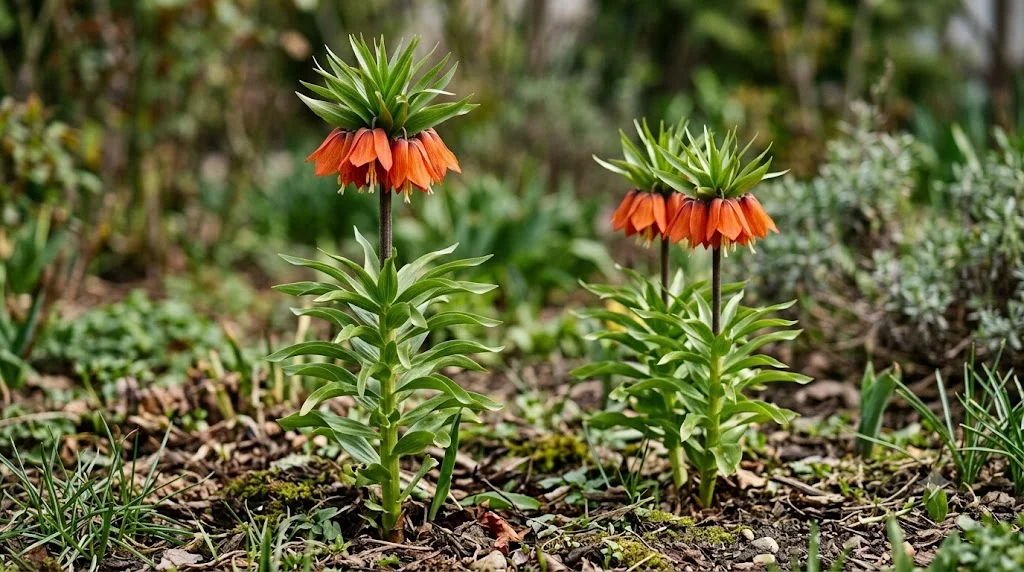

Crown imperial requires very little conventional pruning, but the timing of flower and foliage removal has a major influence on future performance. The most important rule is to preserve healthy green leaves after flowering because they continue producing energy that is stored in the bulb. Spent flowers may be removed when seed is not required, while stems and leaves should remain until they have naturally yellowed and dried. Correct cutting-back practices keep the planting tidy without interrupting the plant’s essential seasonal cycle.
Removing spent crown imperial flowers
Deadheading can be carried out once individual flowers begin to fade. Removing the developing seed structures prevents the plant from investing additional energy in seed production. This can help direct resources toward bulb replenishment instead. Deadheading is especially useful when propagation from seed is not planned.
The flowering portion can be removed carefully without cutting away healthy leaves unnecessarily. Clean, sharp secateurs produce a neat cut and reduce crushing of stem tissue. Tools should be disinfected if they have previously contacted diseased plants. Good hygiene is particularly useful in collections containing many bulb species.
There is no horticultural need to remove faded flowers immediately if appearance is not a concern. Crown imperial can complete seed development naturally when seeds are wanted. Allowing some plants to set seed may be worthwhile for propagation or breeding. The decision depends on the gardener’s objective.
Deadheading should not be confused with full stem removal. The stem and associated green tissues can still contribute to photosynthesis after flowering. Removing everything at once sacrifices useful leaf area. Selective cutting preserves the plant’s ability to rebuild reserves.
More articles on this topic
When to cut back the foliage
Foliage should remain in place until it turns yellow naturally. This visible decline signals that the plant is withdrawing nutrients and carbohydrates from the leaves. During this period, the bulb is preparing for dormancy and the following spring. Premature cutting interrupts this process.
The waiting period can seem untidy in highly designed borders. Nearby perennials can help conceal declining leaves without interfering with their function. Ground-cover plants and later-emerging herbaceous species are particularly useful. Tying, braiding, or folding green leaves should be avoided because these practices reduce effective photosynthetic area.
Once the foliage is completely yellow or brown, it can be cut close to ground level. At this stage, very little useful photosynthetic activity remains. Dry stems may sometimes detach easily with gentle handling. If resistance is strong, cutting is safer than pulling.
Removed healthy foliage can usually be composted. Material showing significant disease should be handled more cautiously so that potential pathogens are not unnecessarily redistributed. Garden tools should be cleaned after working with suspicious tissue. Simple sanitation supports healthier bulb plantings over time.
More articles on this topic
Pruning mistakes and long-term management
One of the most common mistakes is treating crown imperial like a summer bedding plant and cutting it back immediately after bloom. This creates a tidy border temporarily but can weaken the bulb. Repeated premature cutting may result in smaller plants and fewer flowers. The effects can accumulate over several seasons.
Another mistake is cutting foliage because leaf tips have become slightly damaged. Minor frost scorch, wind injury, or isolated leaf spots do not necessarily justify removing an entire healthy leaf. Functional green tissue should generally remain whenever possible. Only severely diseased or collapsing tissue needs early removal.
Pruning cannot correct problems caused by insufficient light, poor drainage, or nutrient imbalance. A weak crown imperial should not automatically be cut harder in an attempt to stimulate growth. Bulbs respond differently from woody shrubs that may regenerate after strong pruning. Their annual performance depends heavily on preserving the limited foliage produced each spring.
The best maintenance routine is therefore minimal and precisely timed. Remove spent flowers if seed is unwanted, preserve the green foliage, and cut the plant back only after natural senescence. This approach respects the crown imperial’s biological cycle while keeping long-term maintenance simple. When combined with good drainage and adequate light, careful cutting helps maintain strong flowering year after year.