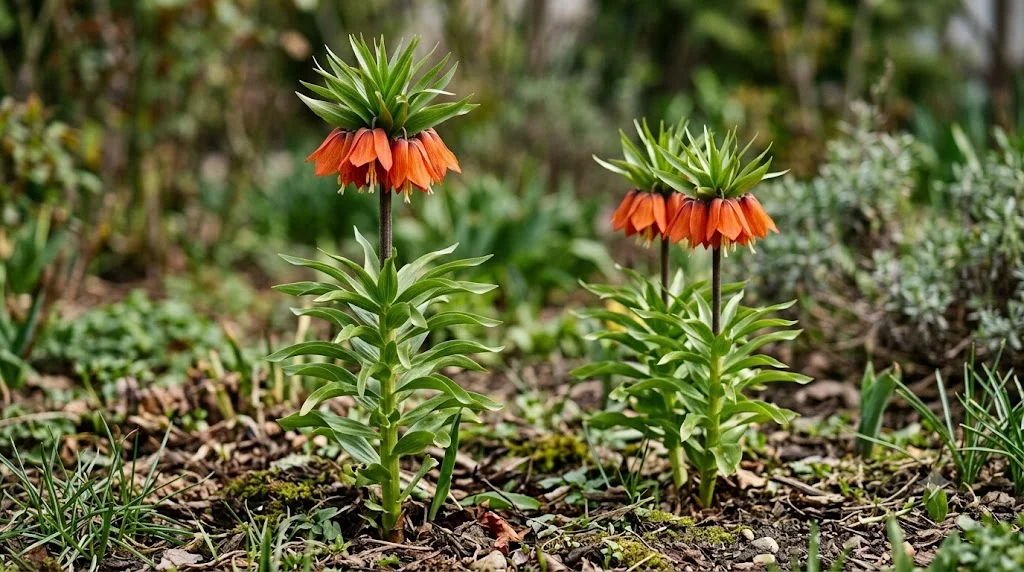

Planting crown imperial correctly is the foundation of reliable flowering because the large bulbs are particularly sensitive to stagnant moisture and physical damage. Choosing a sunny, well-drained position and placing the bulb at an appropriate depth gives developing roots the conditions they need before winter. Propagation is usually achieved by separating offsets from mature bulbs, although seed propagation is possible for gardeners willing to wait several years for flowering. Careful handling at every stage is important because freshly lifted crown imperial bulbs are relatively delicate and should not remain out of the soil unnecessarily.
Choosing and preparing crown imperial bulbs
High-quality bulbs should feel firm and heavy for their size. Crown imperial bulbs naturally have a central depression where the previous stem emerged, so this feature should not be mistaken for damage. Soft areas, extensive mould, unpleasant decay, or collapsed tissue are warning signs. Healthy planting material is the first defence against poor establishment.
Bulbs are normally planted during autumn so that roots can develop before winter. Early to mid-autumn planting is particularly useful because crown imperial bulbs do not benefit from prolonged dry storage. Unlike some smaller spring bulbs, they can lose moisture relatively quickly. Prompt planting therefore supports stronger establishment.
The planting bed should be prepared deeply before the bulbs are placed. Compacted layers beneath the planting hole can trap water and undermine even carefully amended topsoil. Loosening the ground and incorporating mature compost can improve both structure and nutrient availability. In heavy soils, adding coarse drainage material may also be beneficial.
Positioning should be planned with the mature height of the plants in mind. Crown imperial can become an imposing vertical feature, so it works well toward the middle or rear of mixed borders. Several bulbs planted in an informal group create a stronger visual effect than isolated single specimens. Sufficient spacing also allows each plant to develop without excessive competition.
More articles on this topic
Correct planting depth and orientation
Crown imperial bulbs are generally planted deeply compared with many smaller spring bulbs. A planting depth of roughly two to three times the bulb’s height provides good insulation and anchorage, although local soil conditions should also be considered. Very shallow planting can expose bulbs to unstable temperatures and physical disturbance. Excessively deep planting in heavy soil may slow emergence and worsen moisture problems.
Because the bulb has a natural depression at the top, some gardeners worry that water may collect there. Planting the bulb on a slight angle can help moisture drain away from this cavity. The roots will still orient themselves correctly once growth begins. This technique is especially useful in climates with wet autumns and winters.
A layer of coarse sand or fine grit beneath and around the bulb can improve local drainage in heavier soils. This should not create an isolated pocket surrounded by impermeable clay, however. Water must still be able to escape from the wider planting zone. Whole-bed soil improvement is therefore preferable to relying entirely on material placed in the individual hole.
After planting, the soil should be gently firmed without crushing or compressing the bulb. Watering can help settle loose soil around the roots if conditions are dry. There is usually no need for repeated irrigation during a rainy autumn. The goal is contact between soil and bulb without creating saturation.
More articles on this topic
Propagating crown imperial by offsets
Mature crown imperial bulbs often produce smaller daughter bulbs or offsets around the parent. These can be separated during the dormant season once the foliage has completely died back. Lifting should be done carefully with a garden fork positioned well away from the expected bulb location. The bulbs are easily bruised or cut by sharp tools.
Offsets that detach naturally can be replanted separately. Very small bulbs may require several growing seasons before reaching flowering size. During this juvenile period, healthy foliage is more important than immediate flower production. Good nutrition and uninterrupted leaf growth help the young bulbs build reserves.
Replant offsets promptly into prepared, well-drained soil. Their planting depth can be adjusted according to their size, with smaller bulbs positioned somewhat less deeply than fully mature ones. Nevertheless, they should still be sufficiently covered to avoid rapid drying and frost movement. Labeling propagation beds makes it easier to monitor slow-developing plants.
Division should not be performed every year unless there is a specific reason. Frequent disturbance can delay establishment and damage developing roots. Mature clumps can usually remain undisturbed until overcrowding becomes apparent. Propagation is most efficient when division coincides with a genuine need to rejuvenate or relocate the planting.
Growing crown imperial from seed
Seed propagation is possible but much slower than division. Seed-grown plants may take several years before producing flowers large enough to resemble mature specimens. This method is therefore best suited to patient gardeners, collectors, and breeding projects. It is less appropriate when rapid multiplication of a particular cultivar is required.
Fresh seed generally gives the best results because prolonged storage may reduce viability. Seeds can be sown in a free-draining compost and exposed to the seasonal temperature changes needed for germination. Natural outdoor stratification often provides suitable cold conditions. Containers should be protected from becoming waterlogged.
Seedlings are initially small and should be treated as developing bulbs rather than miniature flowering plants. Their foliage must be allowed to mature naturally each season. Regular but moderate feeding can help the tiny bulbs increase in size. Excessive watering during dormancy should still be avoided.
One advantage of seed propagation is genetic variation. Seedlings may differ from the parent plants in vigour, colour intensity, height, or other characteristics. Offsets, by contrast, produce plants genetically identical to the parent cultivar. Choosing between these methods depends on whether uniformity or variation is the desired result.