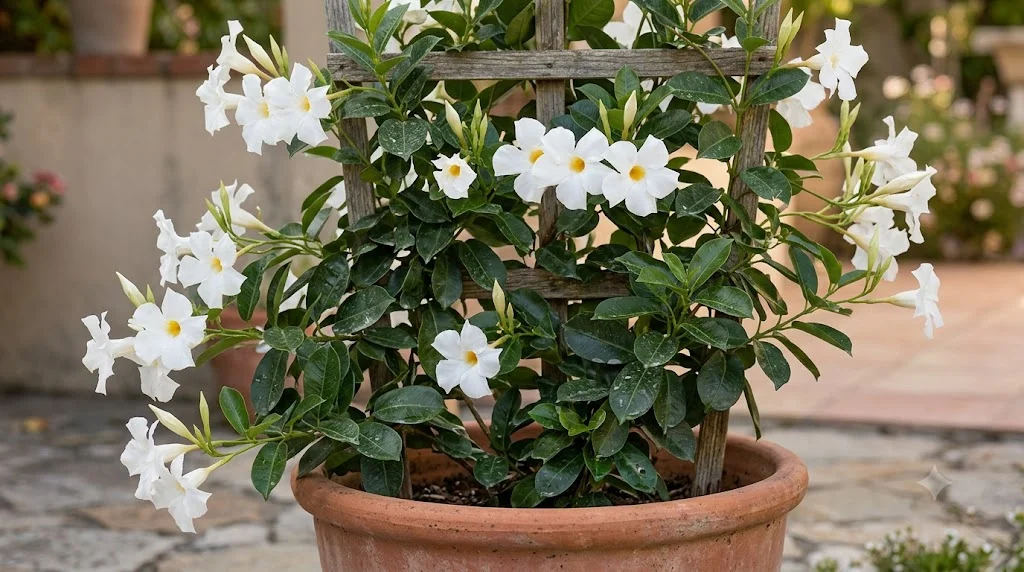

Water and nutrition have a direct influence on the growth, flowering, and resilience of Chilean jasmine. The plant prefers a steady supply of moisture during active growth, yet its roots deteriorate quickly in stagnant, airless compost. Feeding must support both foliage and flower production without forcing soft, unbalanced shoots. A successful routine therefore responds to weather, root volume, growth stage, and the condition of the soil rather than following a rigid calendar.
Understanding moisture requirements
Chilean jasmine uses the most water while producing new shoots, leaves, and flower buds. Large plants trained against warm walls can lose moisture quickly through their foliage. Container-grown specimens are especially vulnerable because their roots cannot search beyond the pot. Daily observation is often more reliable than watering on fixed days.
The upper surface of the compost may dry while deeper layers remain adequately moist. Test several centimetres below the surface before applying more water. A finger, wooden stick, or moisture meter can provide useful guidance, although none should replace observation of the plant. The aim is to maintain even moisture without permanent saturation.
Temporary wilting during a hot afternoon does not always mean the plant requires immediate watering. Leaves may droop because water loss temporarily exceeds root uptake, even when the compost is still moist. If the foliage recovers during the evening, additional water may not be necessary. Watering already-wet roots can create more serious problems than brief heat-related wilting.
Prolonged dryness causes soft shoot tips to collapse and older leaves to yellow or fall. Flower buds may stop developing or drop before opening. Repeated drought also damages fine roots, reducing the plant’s ability to absorb water during later hot periods. Restoring moisture gradually is safer than flooding extremely dry compost.
More articles on this topic
Effective watering techniques
Water should be applied slowly enough to penetrate the entire root ball. A quick splash may wet only the surface while leaving the centre dry. Continue until water begins to emerge from the drainage holes of a container. Empty saucers or decorative outer pots soon afterward so the roots do not stand in water.
Morning is usually the best time to water because the plant can absorb moisture before temperatures rise. Evening watering is acceptable during very hot weather, provided foliage is not kept unnecessarily wet overnight. Direct the water toward the compost rather than spraying the leaves. This reduces evaporation and lowers disease risk.
Garden-grown plants benefit from less frequent but deeper watering after establishment. Deep watering encourages roots to explore a larger volume of soil. Constant shallow watering keeps roots near the surface, where they are more exposed to heat and drying. Mulch can help conserve moisture, but it should not cover the stem base.
Rainfall should not automatically be assumed to have watered a container. Dense foliage can divert rain away from the compost, and pots near walls may remain almost completely dry. Check the growing medium after rainfall before deciding whether irrigation is unnecessary. This is especially important for plants under roof overhangs.
More articles on this topic
Recognising overwatering and poor drainage
Overwatered Chilean jasmine may show yellowing leaves, weak growth, and a generally dull appearance. These symptoms are sometimes mistaken for drought because damaged roots cannot supply water efficiently. The compost may smell sour or remain wet for many days. New shoots can become soft and may die back from the tips.
Root rot develops when oxygen is repeatedly excluded from the root zone. Fine roots are affected first, followed by larger structural roots if conditions do not improve. Brown, soft roots indicate damage, whereas healthy roots are usually firm and pale. Early intervention offers the best chance of recovery.
If a container remains waterlogged, stop watering and check whether the drainage holes are blocked. Remove any standing water from the outer pot or saucer. Where the compost has collapsed or the roots are decaying, repotting into fresh, aerated material may be necessary. Damaged roots should be trimmed with clean tools before replanting.
Outdoor plants in heavy soil may need drainage improvements beyond simple watering adjustments. Diverting roof runoff, loosening compacted surrounding soil, or raising the planting area can help. Adding small amounts of sand to clay soil is rarely sufficient and may create a denser texture. Organic matter and structural improvement are more effective over the long term.
Choosing and applying fertiliser
A balanced fertiliser is useful when spring growth begins. The product should provide nitrogen for leaves, phosphorus for root and flower development, potassium for overall strength, and a range of trace elements. Container plants require feeding more regularly because nutrients are washed from the compost during watering. Garden-grown plants in fertile soil may need fewer applications.
Once flower buds begin to form, a fertiliser with a higher proportion of potassium can support flowering. It should still contain enough nitrogen to maintain healthy foliage. Products formulated for flowering patio plants or tomatoes are often suitable when used at the recommended concentration. Stronger solutions do not produce stronger plants and may burn the roots.
Liquid feeds act quickly and are easy to adjust according to the plant’s response. Slow-release fertilisers provide a steadier supply but are influenced by temperature and moisture. They may release nutrients rapidly during hot weather when frequent watering is also required. Combining full doses of both types can lead to overfeeding.
Always apply liquid fertiliser to moist compost. Feeding a dry root ball increases the risk of concentrated salts damaging fine roots. If the plant has become severely dry, water it first and wait until it has recovered before feeding. Fertiliser cannot correct stress caused by inadequate moisture.
Seasonal feeding and nutrient problems
Begin feeding when the plant is visibly growing rather than according to a fixed date. Cool spring conditions may delay nutrient demand even when the calendar suggests the growing season has started. Continue at moderate intervals through the main flowering period. Reduce feeding as growth slows toward autumn.
Excess nitrogen produces long, soft stems with wide spaces between leaves. Such growth is more vulnerable to pests, wind damage, and cold temperatures. Flower production may decline because the plant invests heavily in foliage. Switching to a lower-nitrogen feed and increasing light can gradually restore balance.
Pale leaves can result from several causes, including nutrient shortage, waterlogging, root congestion, or unsuitable soil reaction. Interveinal yellowing on young leaves may indicate reduced iron availability. Applying iron without correcting poor drainage or high alkalinity offers only temporary improvement. The root environment should always be assessed first.
A white crust on the compost surface or pot rim suggests an accumulation of fertiliser salts. Flush the container occasionally with clean water and allow it to drain thoroughly. Rainwater can be useful in hard-water regions because it contains fewer dissolved minerals. Feeding should be paused until the plant resumes healthy growth.