
Pruning a nordmann fir is an art form that requires a delicate touch, a sharp eye, and a deep respect for the tree’s natural growth habit. You must understand that unlike many deciduous trees or shrubs, most conifers do not readily sprout new growth from old wood if you cut too deeply. Every cut you make is essentially permanent and will influence the shape and health of the tree for the rest of its life. Approaching this task with a clear plan and the right professional tools is the only way to achieve a successful and beautiful result.
The primary goal of pruning a fir should be to support its natural conical form while removing any dead, diseased, or damaged tissue. You should avoid the urge to “shape” the tree into an artificial or overly manicured appearance, as this often goes against its biological instincts. Most nordmann firs require very little pruning if they are planted in the right location with enough room to grow. For these trees, pruning is more about “fine-tuning” and maintenance than it is about radical transformation or size control.
Timing is one of the most critical factors in the success of your pruning efforts, and it depends on what you are trying to achieve. You should perform most structural pruning and the removal of dead wood in the late winter or early spring while the tree is still dormant. This allows the tree to focus its initial burst of spring energy on healing the wounds and putting out new growth. However, if you are looking to manage the density of the tree, a different strategy and timing may be required to work with the tree’s active growth cycle.
Safety is also a major consideration when pruning any large tree, and you must be honest about your own skills and the equipment you have available. You should always wear gloves to protect your hands from the sticky resin and sharp needles, and safety glasses are a must to protect your eyes. If the tree has grown beyond your reach from the ground, it may be time to call in a professional arborist with the specialized training and equipment to work safely at height. Protecting both yourself and the tree is the mark of a truly professional gardener.
Structural pruning and form maintenance
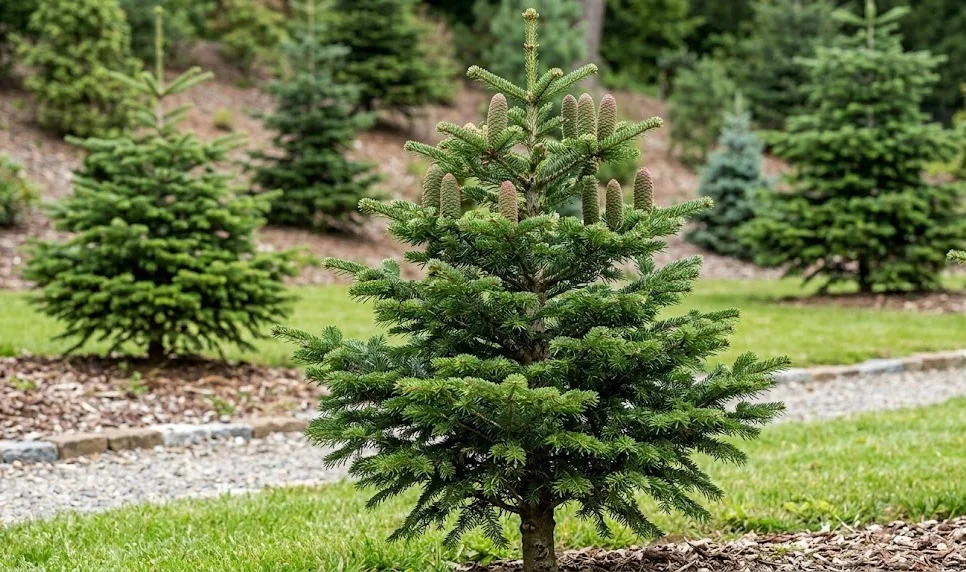
The most important structural feature of a nordmann fir is its central leader, the single vertical stem that grows from the very top of the tree. You must protect this leader at all costs, as its loss can cause the tree to lose its classic shape and develop multiple tops, which are structurally weaker. If the leader is damaged by wind or birds, you should carefully select a strong side branch and train it upward to take the place of the original. This is done by gently splinting the new leader into a vertical position until it hardens off and stays in place on its own.
More articles on this topic
Maintaining a single leader is just the first step; you also need to look for any competing “double leaders” that may emerge from the top whorl of branches. You should remove these competitors as soon as you notice them, as they will compete for dominance and eventually ruin the tree’s symmetry. Making this cut early while the branches are still small ensures that the wound heals quickly and the tree’s energy is directed back into the main stem. A single, strong leader is the key to a long-lived and structurally sound specimen in any landscape.
Thinning out crowded or crossing branches is another important part of structural maintenance that helps improve air circulation and light penetration. You should look for branches that are growing inward toward the trunk or those that are rubbing against each other, as these can create wounds and entry points for disease. By carefully removing the smaller or weaker of the two crossing branches, you allow the tree to focus its resources on its most healthy and productive wood. This type of selective thinning is much better for the tree than a general “haircut” across the entire canopy.
Finally, you should pay attention to the balance of the tree’s lower branches, which are often the most beautiful but also the most vulnerable to damage. You should avoid “limbing up” or removing the lower branches unless it is absolutely necessary for access or visibility around the base. A fir that is allowed to keep its branches all the way to the ground has a much more natural and majestic appearance. If a lower branch must be removed, do so carefully and make sure to leave the branch collar intact to ensure proper healing of the main trunk.
Timing and techniques for various cuts
Late winter is the ideal time for the majority of pruning tasks because the tree’s metabolic rate is low and the lack of foliage on nearby deciduous trees makes it easier to see the structure. You should use this time to clear away any winter damage, such as branches broken by heavy snow or desiccated by freezing winds. These “sanitation” cuts prevent pathogens from moving from dead tissue into the healthy parts of the tree as the weather warms. Working during dormancy also minimizes the amount of sap that will bleed from the cuts, which can be a messy and sticky problem in the spring.
More articles on this topic
If you are looking to increase the density of the tree’s foliage, a technique called “candling” can be used in the late spring or early summer. You should wait until the new growth, which looks like soft green candles at the ends of the branches, has reached its full length but before the needles have fully opened. By pinching off or cutting back half of this new growth, you encourage the tree to put more energy into the remaining needles and the development of next year’s buds. This is a common practice in the Christmas tree industry to create the thick, lush look that many people prefer.
When making a pruning cut, you must always use sharp, clean tools and follow the “three-cut” method for any branches that are too heavy to hold with one hand. This technique prevents the weight of the falling branch from tearing the bark down the trunk, which can cause significant and permanent damage to the tree. First, make an undercut a few inches away from the trunk, then a second cut all the way through from the top further out. Finally, remove the remaining stub with a clean cut just outside the branch collar, the slightly swollen area where the branch meets the trunk.
Avoid the use of pruning paints or wound dressings, as modern research has shown that these products can actually interfere with the tree’s natural healing process. You should let the tree heal itself by producing a specialized tissue called callus, which will eventually grow over the wound and seal it off from the environment. The best way to help the tree heal is to make clean, accurate cuts at the right time of year and ensure the tree is well-watered and healthy. A strong, vigorous tree will close its wounds much more quickly than one that is stressed or under-nourished.
Health-focused trimming and restoration
Sometimes, pruning is not about aesthetics at all but is a necessary intervention to save a tree from disease or infestation. You should be prepared to act quickly if you see signs of canker, blight, or localized pest damage on a specific branch or section of the tree. By removing the infected wood and disposing of it far away from your other trees, you can often stop the spread of a problem before it becomes a disaster. In these cases, the “rules” of aesthetic pruning are secondary to the survival of the tree’s overall health and structural integrity.
Restoring a neglected fir that has been allowed to grow wild or has been damaged by the elements can be a multi-year project. You should not try to fix everything at once, as removing too much foliage in a single year can shock the tree and leave it vulnerable to further stress. Instead, develop a three-to-five-year plan to gradually remove the most problematic branches and encourage new, healthy growth in the right directions. This slow and steady approach is much more likely to result in a successful restoration than a single, drastic intervention.
Pruning for clearance is another practical task that must be handled with care to avoid ruining the tree’s natural beauty. You should only remove as much of the tree as is absolutely necessary to clear a walkway, a driveway, or a nearby building. Whenever possible, try to use the selective thinning techniques we discussed earlier rather than simply shearing off the ends of the branches. This maintains the soft, natural texture of the fir and prevents the “boxed-in” look that results from improper trimming of conifers.
Finally, always take the time to step back and look at the tree from several different angles after every few cuts you make. You should ensure that you are maintaining the overall balance and that the tree still looks like a nordmann fir when you are finished. It is very easy to get “lost” inside the dense branches and make a mistake that you can’t undo, so frequent perspective checks are essential. Pruning is a conversation between you and the tree, and by listening to what the tree needs, you can ensure it remains a healthy and beautiful part of your garden for generations.