
Apple scab, caused by the persistent fungal pathogen Venturia inaequalis, remains one of the most economically devastating diseases affecting apple orchards worldwide. Commercial growers face significant challenges when dealing with this disease because it directly compromises both the aesthetic value and structural integrity of the crop. Without a proactive and thoroughly planned management strategy, an orchard can suffer near-total yield loss within a single wet growing season. Understanding the fundamental nature of this threat is the first step toward establishing a robust defense system that safeguards orchard profitability.
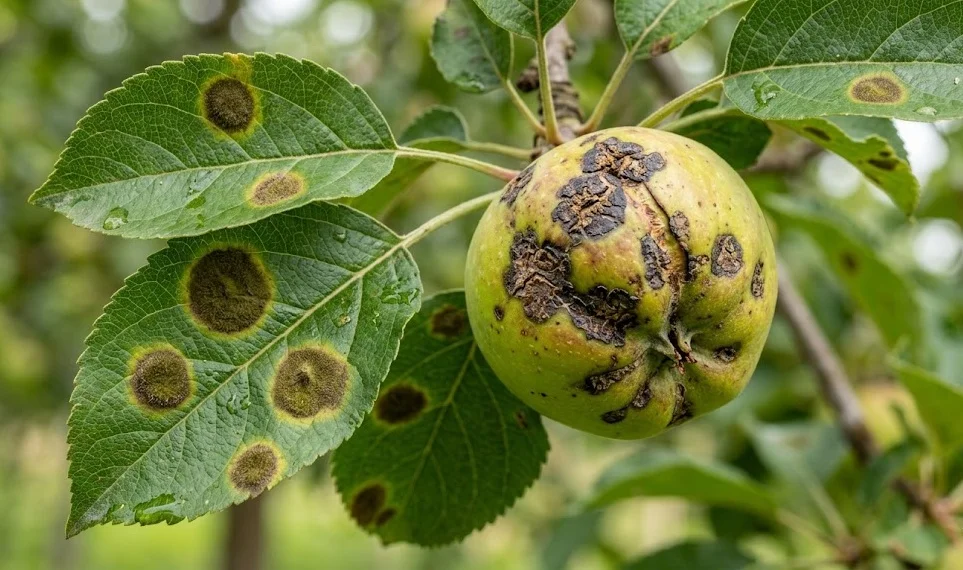
Initial identification relies heavily on recognizing the distinctive symptoms that manifest on the young foliage during the early spring months. The infection typically presents as small, olive-green or brown spots on both the upper and lower surfaces of the leaves. Over time, these lesions develop a velvety texture due to the production of asexual spores, and they eventually turn dark brown or black. Severe leaf infections cause premature defoliation, which severely reduces the tree’s photosynthetic capacity and weakens its overall vigor for subsequent seasons.
The impact on the fruit is even more damaging and presents a direct threat to marketability. Lesions on the fruit start as small, circular spots that gradually expand, turning brown and corky as the tissue dies. As the infected apple grows, the skin frequently cracks, exposing the flesh to secondary rot organisms and causing severe deformation. These blemished fruits are entirely unsuitable for the fresh market, forcing growers to sell them at a fraction of the price for processing or discard them completely.
Environmental factors play a definitive role in the severity of apple scab outbreaks across different geographical regions. The fungus thrives in cool, wet spring weather, where prolonged periods of leaf wetness provide ideal conditions for spore germination. Changing global weather patterns have introduced unpredictable rainfall events, making traditional calendar-based management schedules increasingly unreliable. Therefore, a modern agricultural approach requires an intricate understanding of how these environmental variables interact with the pathogen.
Biological lifecycle and infection pathways of the pathogen
The ability of Venturia inaequalis to persist year after year depends entirely on its specialized overwintering strategy. When infected leaves fall to the ground in autumn, the fungus shifts from a parasitic lifestyle to a saprophytic one within the dead tissue. Throughout the winter, it develops specialized fruiting bodies known as pseudothecia inside the decaying leaves on the orchard floor. The rate of maturation for these structures is highly dependent on ambient temperatures and moisture levels during the colder months.
As spring arrives, the pseudothecia mature and become filled with sexual spores called ascospores. Rainfall events trigger a mechanical response that forcibly ejects these ascospores into the air currents, allowing them to travel upward into the green canopy. Once they land on expanding leaves or developing fruit clusters, they require a continuous film of water to germinate and penetrate the protective plant cuticle. This initial phase constitutes the primary infection period, which sets the baseline for disease pressure for the rest of the year.
Following successful primary colonization, the fungus establishes visible lesions and initiates its asexual reproduction phase. Within these spots, millions of asexual spores, known as conidia, are produced and stand ready to spread the disease further. Unlike ascospores, conidia are primarily disseminated by wind and splashing rain drops throughout the immediate tree canopy. This secondary infection cycle repeats multiple times throughout the summer months whenever moisture levels permit, leading to an exponential increase in disease severity.
The cycle closes in late autumn when the trees begin to shed their leaves in preparation for dormancy. The fungus hitches a ride to the ground within this falling organic matter, ensuring its survival into the next calendar year. Recognizing the precise transitions between these sexual and asexual stages allows agronomists to identify critical vulnerabilities in the pathogen’s timeline. Targeting these specific windows maximizes the efficiency of control measures while minimizing unnecessary interventions.
Cultural management and orchard sanitation protocols
Orchard sanitation forms the foundational layer of defense against apple scab by directly targeting the overwintering primary inoculum. Since the fungus relies on fallen leaves to survive the winter, removing or destroying this debris significantly lowers the spring spore load. Flail mowing in late autumn is a highly effective cultural practice that shreds fallen leaves into tiny fragments. This mechanical disruption accelerates the natural decomposition of the organic matter, leaving the fungus without a viable habitat to complete its lifecycle.
Another powerful sanitation technique involves the strategic application of a five percent urea solution to the orchard floor and canopy right before leaf drop. The added nitrogen acts as a nutritional catalyst for beneficial soil bacteria and earthworms, which rapidly consume the fallen leaves. Furthermore, high concentrations of urea exert a direct inhibitory effect on the development of the fungal pseudothecia themselves. Studies demonstrate that this simple chemical intervention can reduce the subsequent spring ascospore discharge by over eighty percent.
Canopy architecture management through meticulous winter and summer pruning represents another indispensable cultural control method. Removing crowded or redundant branches opens up the interior of the tree, allowing for maximum sunlight penetration and improved air circulation. Consequently, wet leaves and fruit dry much faster after a rain event, shortening the critical window required for spore germination. Additionally, an open canopy ensures that any applied protective sprays can penetrate deeply and coat all plant surfaces uniformly.
Site selection and row orientation are equally critical long-term considerations when establishing a new commercial orchard block. Rows should ideally be aligned parallel to prevailing winds to encourage rapid drying throughout the rows after precipitation. Avoid planting susceptible varieties in low-lying pockets of land where cold air and morning fog tend to settle for extended periods. Combining these fundamental cultural practices creates a less hospitable environment for the fungus, significantly reducing the pressure on subsequent chemical control options.
Utilizing genetic resistance and cultivar selection
The deployment of scab-resistant apple cultivars represents one of the most sustainable long-term strategies for minimizing disease pressure. For decades, agricultural breeding programs have worked to introduce specific resistance genes into high-quality commercial varieties. The most famous of these is the Vf gene, which was originally bred from the wild apple species Malus floribunda. Planting varieties that naturally possess this genetic shield allows growers to drastically reduce their reliance on seasonal fungicide applications.
Modern growers have access to an impressive array of scab-resistant varieties that satisfy both agronomic demands and consumer preferences. Cultivars such as Topaz, GoldRush, Enterprise, and CrimsonCrisp offer robust resistance alongside excellent flavor profiles and storage capabilities. These varieties perform exceptionally well in organic production systems where chemical options are highly restricted. Integrating these genetically armed trees into a commercial operation minimizes production risks and lowers overall input costs over the lifetime of the orchard.
However, relying entirely on genetic resistance presents long-term challenges due to the highly adaptive nature of Venturia inaequalis. Over time, localized populations of the fungus can undergo mutations that allow them to bypass single-gene resistance mechanisms. This phenomenon, known as resistance breakdown, has already been documented in several regions where the Vf gene was heavily relied upon. When a single genetic barrier fails, the cultivar suddenly becomes vulnerable to severe infection, highlighting the danger of monoculture approaches.
To counteract this threat, modern breeders focus on pyramid engineering, which combines multiple distinct resistance genes within a single cultivar. This multi-layered genetic defense makes it exponentially more difficult for the pathogen to mutate and overcome the plant’s immune system simultaneously. Growers can also interplant resistant varieties with tolerant ones to diversify the genetic landscape of the orchard block. Managing genetic resources with the same care as chemical tools ensures that these valuable varieties remain functional for future generations.
Chemical intervention strategies and protectant programs
Fungicides remain an essential component of apple scab management in conventional production systems, particularly during high-pressure spring seasons. The backbone of any effective chemical spray program is the strategic application of protectant fungicides, which must be present on the tissue before spores arrive. These products work by creating a toxic barrier on the surface of leaves and fruit that prevents spore germination and penetration. Common protectants, including mancozeb and captan, offer broad-spectrum multi-site activity, making it virtually impossible for the fungus to develop resistance to them.
In contrast to protectants, systemic fungicides offer curative or post-infection activity, frequently referred to in the industry as kickback action. These specialized compounds penetrate the leaf tissue and can eradicate the fungus even after an infection process has already begun. This capability provides crucial operational flexibility when unexpected or prolonged rain events prevent timely protectant applications. However, these curative materials must be applied within a strict time window, typically twenty-four to seventy-two hours following the start of an infection period.
Managing the risk of chemical resistance is a critical consideration when designing a seasonal fungicide rotation program. Systemic fungicides, such as DMIs, SDHIs, and strobilurins, target single specific sites within the metabolic pathway of Venturia inaequalis. Because of this narrow focus, the fungus can quickly develop resistance if the same class of chemistry is used repeatedly. Growers must rotate between different chemical classes with distinct modes of action and frequently tank-mix them with broad-spectrum protectants to preserve product efficacy.
The physical application process itself requires careful calibration and precision timing to achieve satisfactory control levels. Spray equipment must be regularly checked to ensure that nozzle patterns provide thorough, uniform coverage across the entire canopy profile. Gaps in spray coverage create unprotected zones where the fungus can easily establish primary lesions, compromising the entire program. Proper timing combined with flawless execution ensures that chemical investments translate directly into a clean, marketable harvest.
Implementation of forecasting models and digital technology
Modern apple production has moved away from rigid, calendar-based spray programs in favor of precision agriculture driven by digital technology. Disease forecasting models utilize real-time environmental data collected by automated weather stations installed directly within the orchard blocks. These sensors continuously monitor critical variables such as temperature, relative humidity, and the precise duration of leaf wetness periods. By analyzing these specific inputs, computer models can accurately calculate whether an infection event has occurred and determine its potential severity.
The classic Mills criteria, along with its modern revisions, serves as the mathematical foundation for these advanced forecasting algorithms. Software platforms like RIMPRO or Welte simulate the dynamic behavior of the pathogen, tracking ascospore maturation, ejection, and subsequent infection progress in real-time. This real-time analysis provides orchard managers with a clear, visual representation of the current risk level on their electronic devices. Armed with this precise information, growers can make highly informed decisions regarding if and when a spray intervention is genuinely necessary.
Integrating digital forecasting models into the decision-making process allows growers to optimize their chemical usage without increasing crop risk. During dry spring seasons, models frequently demonstrate that infection conditions were not met, enabling growers to skip unnecessary spray applications safely. Conversely, during high-risk periods, the technology alerts managers to reinforce their protective barriers before damage occurs. This balanced approach reduces overall production costs, minimizes environmental chemical loads, and slows down the development of fungicide resistance.
However, digital tools should always be used in tandem with routine physical scouting protocols to ensure maximum accuracy. Field scouts should regularly inspect indicator varieties that are highly susceptible to apple scab to catch early primary lesions. These physical observations validate the predictions made by the digital models and help recalibrate the software parameters if discrepancies arise. Combining cutting-edge technology with traditional boots-on-the-ground agronomy provides the highest level of security for commercial fruit operations.
Integrated pest management and sustainable future horizons
Successful long-term management of Venturia inaequalis requires a comprehensive Integrated Pest Management framework that synthesizes all available strategies. Relying solely on chemical interventions or genetic resistance creates a fragile system that is prone to eventual failure through resistance breakdown. An integrated system blends cultural sanitation, genetic selection, digital forecasting, and targeted chemical applications into a multi-layered defensive strategy. This balanced approach views the orchard as a complex ecosystem where every management action influences the broader biological equilibrium.
The exploration of biological control agents represents an exciting and rapidly developing frontier in sustainable apple production. Researchers are actively studying naturally occurring antagonistic fungi, such as Cladosporium cladosporioides, which aggressively compete with the scab pathogen for space and nutrients. When applied to fallen leaves in autumn, these beneficial microbes significantly inhibit the formation of overwintering pseudothecia. Additionally, biopesticides derived from plant extracts and microbial metabolites are showing great promise as low-impact alternatives to conventional chemistry.
Climate change introduces a new layer of complexity to the epidemiology of apple scab, requiring adaptive management strategies. Shifting weather patterns are causing milder winters, which can accelerate the maturation of overwintering spores and lead to earlier spring releases. More frequent, intense spring rain storms also challenge conventional spray logistics by washing away protectant residues and limiting tractor access to muddy fields. Growers must remain flexible and continually update their management plans to cope with these evolving environmental baselines.
Ultimately, managing apple scab effectively requires a proactive mindset grounded in continuous learning and scientific collaboration. Agronomists, researchers, and commercial growers must work together to share field data and refine best practices for regional climates. Investing time into understanding the biological mechanics of the pathogen pays significant dividends in the form of healthier trees and superior fruit quality. Dedication to sustainable, integrated practices ensures that apple orchards remain profitable, resilient, and productive for decades to come.