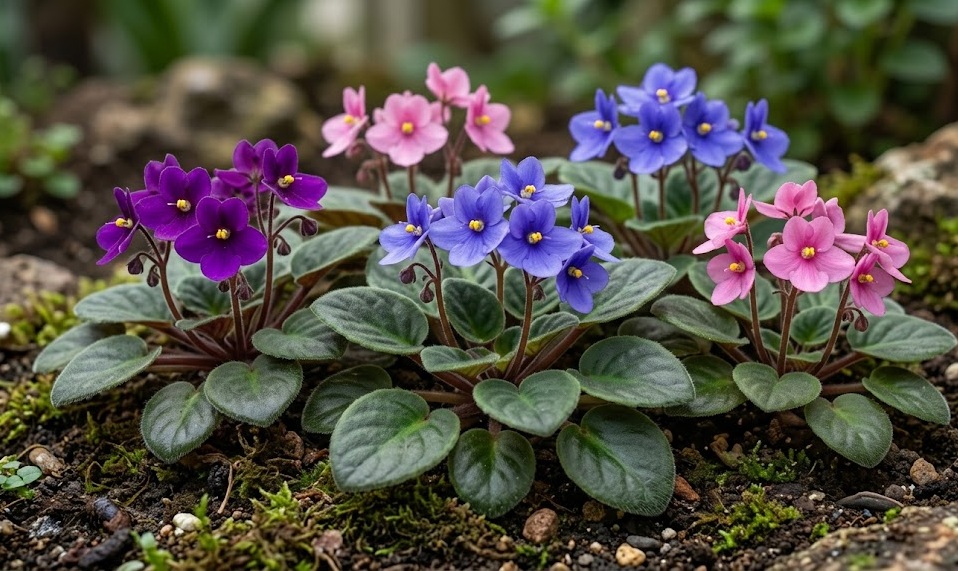

Providing the correct intensity of light is perhaps the most important factor in determining whether your African violet will bloom or just grow leaves. These plants require bright, indirect light for about twelve to fourteen hours a day to produce the energy needed for consistent flower production. In their natural habitat, they grow under the canopy of trees, receiving filtered sunlight that is bright but never harsh. In a home setting, an east-facing window is often the most reliable location, offering gentle morning sun and bright light for the rest of the day.
A simple way to test the light intensity at your plant’s location is the “shadow test” on a bright day. Hold your hand about a foot above the plant’s position; you should see a soft, blurry shadow rather than a sharp, dark one. If there is no shadow at all, the light is likely too weak for the plant to produce flowers consistently. If the shadow is very dark and distinct, the light is too intense and could lead to leaf scorch or bleaching of the foliage.
During the summer months, you may need to use a sheer curtain to filter the light from south or west-facing windows to prevent overheating. The heat from direct afternoon sun can be just as damaging as the light intensity itself, causing the plant to wilt and the flowers to fade prematurely. You should also be mindful of the distance between the plant and the glass, as temperatures can vary significantly right at the windowpane. Finding the perfect balance of brightness and protection is an essential skill for every serious grower.
Consistency is just as important as intensity when it comes to lighting for these sensitive tropical plants. Sudden changes in light levels, such as moving a plant from a dark corner to a sunny windowsill, can cause the plant to go into shock. If you need to move your plant to a brighter location, do it gradually over several days to allow the leaves to adapt. This careful approach prevents cellular damage and ensures that the plant continues to thrive in its new environment.
Signs of light stress
Recognizing the physical signs of light stress allows you to make necessary adjustments to your plant’s location before permanent damage occurs. If your African violet is getting too much light, the leaves will often start to bunch up in the center, and the overall rosette will become very compact. The foliage may also take on a pale, bleached appearance, or you might see brown, crispy spots where the sun has literally burned the leaf tissue. In some cases, the leaves may even start to curl downward to protect the sensitive underside of the foliage.
More articles on this topic
On the other hand, a lack of light produces a very different set of symptoms that are just as detrimental to the plant’s health. The most obvious sign is a complete stop in flower production, as the plant simply doesn’t have enough energy to produce buds. The leaves will often reach upward toward the light source, and the stems (petioles) will become unusually long and weak. The plant may also lose its vibrant green color, becoming a dull, dark green as it tries to maximize its limited photosynthetic capacity.
If you notice your plant leaning heavily in one direction, it is a clear sign that the light source is one-sided and the plant is stretching to reach it. You can correct this by regularly rotating the pot, but a better long-term solution is to provide more balanced lighting. A plant that is consistently struggling for light will be much more susceptible to pests and diseases because its overall vigor is compromised. Monitoring the “body language” of your African violet is the best way to ensure it is happy with its lighting situation.
The color of the flowers can also be affected by the intensity and quality of the light they receive. Some varieties with multi-colored or “fantasy” blooms may lose their distinct patterns or turn a solid color if the light is too low or too high. If you want to see the true potential of a specific cultivar, you must provide the precise lighting conditions it was bred to enjoy. Keeping a close eye on these subtle changes will help you become a much more successful and intuitive indoor gardener.
Artificial lighting solutions
For many enthusiasts, artificial lighting is the only way to provide the consistent and high-quality light that African violets need to look their best. Fluorescent tubes or modern LED grow lights allow you to grow beautiful plants even in basement rooms or dark apartments without windows. LEDs are particularly popular today because they produce very little heat and can be tuned to the specific wavelengths of light that plants use for photosynthesis. A high-quality LED setup can result in faster growth and more intense flower colors than natural light alone.
More articles on this topic
When setting up an artificial light system, the distance between the top of the plants and the light source is a critical technical detail. For standard fluorescent shop lights, a distance of about eight to ten inches is usually ideal for maintaining healthy growth. If you are using powerful LEDs, you may need to increase this distance to twelve or even eighteen inches to avoid light stress. You should observe your plants closely after installing new lights and adjust the height until the growth looks symmetrical and healthy.
The duration of the light period, known as the photoperiod, should be strictly controlled using an automatic timer. Most African violets perform best with about twelve to fourteen hours of light, followed by at least eight hours of total darkness. The dark period is just as important as the light period because it is when the plant processes the energy it has gathered during the day. Without a regular cycle of light and dark, the plant’s internal biological clock will be disrupted, leading to poor health and a lack of blooms.
Using artificial lights also gives you the ability to grow a much larger collection of plants in a relatively small amount of space. You can use multi-tiered shelving units with lights attached to the underside of each shelf to create a highly efficient vertical garden. This setup allows you to control the environment perfectly, from the temperature and humidity to the precise amount of light each plant receives. Artificial lighting is a game-changer for anyone who wants to take their African violet hobby to a professional level.