
The ability of garlic to survive and thrive during the coldest months of the year is a testament to its remarkable biological resilience. Overwintering is not merely a period of dormancy; it is a critical phase where the plant establishes its root system and undergoes the cooling process necessary for bulb formation. A professional approach to winter care ensures that the cloves are protected from extreme fluctuations and prepared for rapid spring growth. This guide details the essential strategies for successfully managing garlic throughout the winter season.
The biological importance of the cold period
Garlic requires a physiological process called vernalization, which is triggered by exposure to cold temperatures for a specific duration. Without this cold period, the cloves would likely fail to split into individual segments, resulting in a single, large “round” rather than a multi-cloved bulb. Most varieties need several weeks of temperatures below ten degrees Celsius to complete this transition. This evolutionary adaptation ensures that the plant only begins its intensive reproductive phase when the favorable conditions of spring arrive.
During the winter months, while the top of the plant may show little to no growth, the root system is often quite active. Cloves planted in the autumn use this time to anchor themselves deeply into the soil before the ground freezes solid. A strong root system developed during the winter allows the plant to access moisture and nutrients more efficiently as soon as the thaw begins. This early foundation is what gives autumn-planted garlic a significant head start over spring-planted alternatives.
The depth of dormancy varies between different types of garlic, with some hardneck varieties being much more cold-hardy than others. Softneck varieties, often grown in milder climates, may maintain some green foliage throughout the winter if the temperatures remain moderate. Regardless of the type, the plant’s metabolism slows down significantly to conserve energy and protect its cellular structure from frost damage. Understanding this quiet phase of the life cycle is essential for any professional gardener aiming for a high-quality harvest.
Soil temperature is often more important than air temperature during the overwintering process. The soil acts as a thermal buffer, protecting the delicate cloves from the rapid changes in the atmosphere. As long as the cloves do not freeze and thaw repeatedly, they are remarkably capable of surviving even sub-zero temperatures. Managing the soil environment to maintain a steady, cold temperature is the primary goal of the overwintering strategy.
More articles on this topic
Applying mulch for thermal protection
The application of a thick layer of organic mulch is the most effective way to protect overwintering garlic from environmental stress. Materials such as clean wheat straw, shredded leaves, or even pine needles provide a layer of insulation that stabilizes soil temperatures. A mulch layer of ten to fifteen centimeters is generally recommended for regions with cold winters. This “blanket” prevents the soil from freezing and thawing rapidly, a process known as frost heaving that can literally push the cloves out of the ground.
Mulching also serves to conserve soil moisture throughout the winter, preventing the cloves from drying out during long periods without precipitation. Even in a dormant state, the roots require a small amount of hydration to remain viable. The mulch layer reduces evaporation from the soil surface and helps trap snow, which is itself an excellent natural insulator. By the time spring arrives, the soil under the mulch is often in much better condition than bare earth.
Choosing the right mulch material is important to avoid introducing weed seeds or pathogens into the garlic bed. Straw should be free of grain heads, and leaves should be shredded to prevent them from matting down into an impermeable layer. Some growers prefer to use a layer of compost covered by straw to provide both insulation and a slow-release nutrient boost for the spring. The mulch should be applied after the first few light frosts but before the ground freezes hard.
In areas with very high winds, it may be necessary to secure the mulch with a light netting or by scattering a small amount of soil over the top. If the mulch is blown away, the garlic becomes vulnerable to the direct impact of freezing winds and temperature spikes. Checking the integrity of the mulch layer periodically during the winter is a simple but vital maintenance task. A well-maintained mulch layer is the garlic’s best defense against the harshest elements of the season.
More articles on this topic
Managing winter moisture and drainage
While garlic needs some moisture during the winter, excessive water can be a major threat to the survival of the cloves. Saturated soil in cold temperatures is a perfect environment for rot-inducing fungi to take hold and destroy the planting material. Ensuring that the planting site has excellent drainage is a critical part of the overwintering plan. In heavy clay soils, growing garlic in raised beds is often the most reliable way to prevent winter waterlogging.
Snow cover is generally beneficial for garlic, as it provides additional insulation and a slow, steady source of moisture as it melts. However, a rapid melt followed by a sudden freeze can create an ice crust on the soil surface that may interfere with gas exchange. Most garlic plantings can handle this for a short period, but prolonged ice cover can be problematic. A professional gardener observes these patterns and ensures that runoff from melting snow is directed away from the garlic beds.
In regions with very dry winters and little snow, supplemental watering may be necessary if the ground is not frozen. The goal is not to keep the soil wet, but to prevent it from becoming bone-dry, which can damage the developing root systems. This should only be done during a mid-winter thaw when the water can actually penetrate the soil surface. Careful monitoring of local weather patterns allows for these rare but sometimes necessary interventions.
The structure of the soil itself plays a role in how it handles winter moisture. Soil that is rich in organic matter has a better ability to hold the right amount of water while allowing the excess to drain away. This is another reason why preparing the soil with compost before planting is so beneficial for the overwintering phase. A healthy soil structure acts as a natural regulator for the moisture levels that the garlic cloves experience during their dormancy.
Spring emergence and the end of dormancy
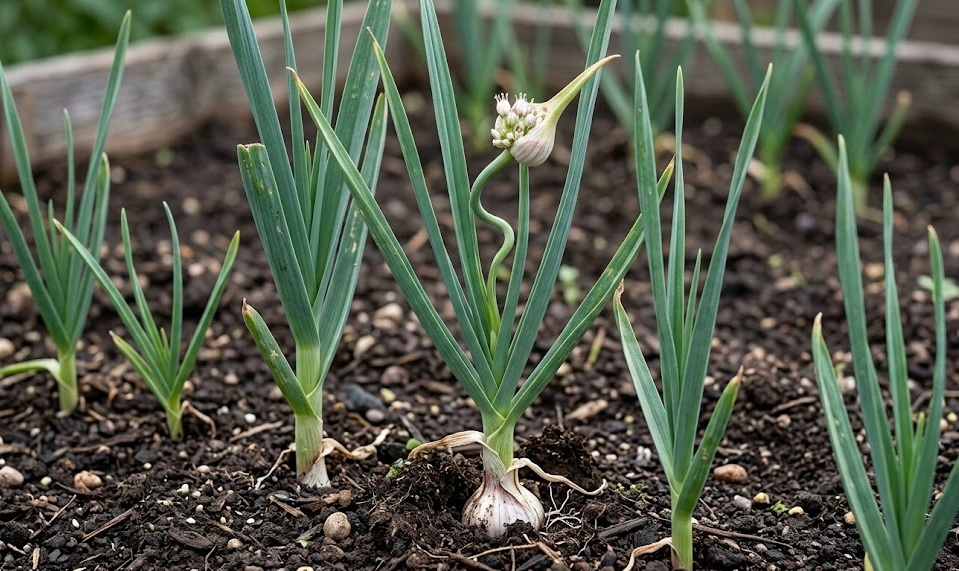
As the days lengthen and the soil begins to warm in the early spring, the garlic will signal its awakening by sending up green shoots. These first tips of green are a welcome sight and mark the successful completion of the overwintering process. At this point, the gardener must decide when and how to manage the mulch layer to facilitate growth. If the mulch is very thick, it may need to be lightly pulled back from the emerging shoots to prevent them from becoming trapped or yellowed.
Early spring is a time of transition where the risk of late frosts still exists, but the plant is ready to grow rapidly. The garlic’s internal clock is fine-tuned to react to the increasing light and temperature, triggering a surge of metabolic activity. This is the moment when the first application of spring fertilizer is most effective, providing the nutrients needed for the upcoming vegetative explosion. The resilience developed during the winter is now put to use in the race toward bulb formation.
It is important not to be too hasty in removing the entire mulch layer, as it still provides valuable weed suppression and moisture retention. Many professional growers leave most of the mulch in place throughout the entire growing season, only clearing the area directly around the plants. This maintains the benefits of the mulch while allowing the garlic to breathe and expand. The transition from winter protection to spring maintenance should be a gradual and observed process.
The success of the overwintering phase is measured by the uniformity and vigor of the spring emergence. A bed where every clove has survived and sprouted strongly is the result of proper planting depth, good drainage, and effective thermal protection. This successful start provides the foundation for the final months of the growth cycle and the ultimate harvest. Overwintering is a quiet but powerful part of the garlic’s journey from a single clove to a magnificent bulb.