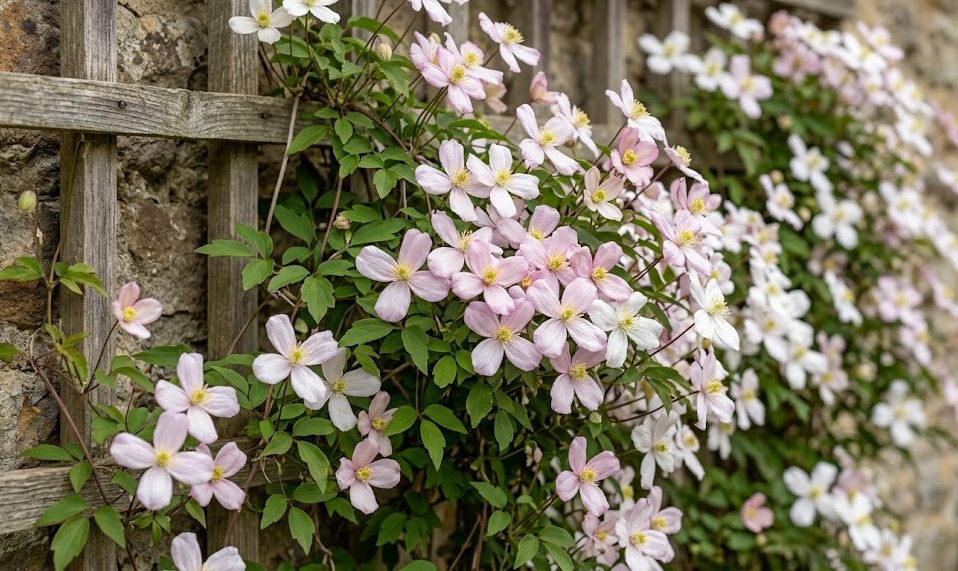

Pruning is perhaps the most misunderstood aspect of caring for mountain clematis, yet it is a powerful tool for managing its size and ensuring its continued vitality. Unlike the large-flowered hybrids that require complex pruning schedules, this vigorous species is remarkably forgiving and easy to handle once you understand its basic growth cycle. The goal of pruning here is not to force the plant into a specific shape, but rather to keep it within its boundaries and encourage healthy new wood. A well-timed and executed pruning routine will result in a more manageable and beautiful climber year after year.
Mountain clematis belongs to “Pruning Group 1,” which means it flowers on the previous year’s growth and requires very little regular maintenance. For many gardeners, the best approach is to let the plant grow freely and only intervene when it starts to outgrow its space or becomes too dense. If you prune the plant at the wrong time of year, you run the risk of cutting off all of the flower buds and missing out on the spring display. Understanding the timing of the bloom is the most critical piece of information for any gardener with a pair of shears in their hand.
The ideal time to prune a mountain clematis is immediately after it has finished flowering in the late spring or early summer. By pruning at this stage, you give the plant the maximum amount of time to grow new stems and develop buds for the following year. If you wait until the autumn or winter to cut it back, you will almost certainly be removing the very branches that would have carried the next season’s flowers. This “post-bloom” pruning window is a golden rule for all members of the montana group and should be strictly followed for the best results.
When you do decide to prune, start by removing any dead, damaged, or diseased wood to maintain the overall health of the structure. This initial clean-up allows you to see the main framework of the plant more clearly and makes the subsequent shaping much easier. You should also look for any stems that are rubbing against each other or growing in an undesirable direction, such as into gutters or under roof tiles. Taking the time to do a “structural” prune every year prevents the plant from becoming a tangled mess that is difficult to manage later.
Techniques for routine maintenance
For a plant that is already the desired size, routine maintenance involves a light thinning and shortening of the most vigorous new shoots. You can use sharp bypass pruners to cut back the long, trailing stems to a point just above a healthy pair of leaves or buds. This technique, known as “heading back,” encourages the plant to branch out and become bushier rather than just growing longer and longer. It is an excellent way to maintain a solid screen of foliage on a fence or wall without allowing the plant to become too heavy.
More articles on this topic
In some cases, the interior of the vine can become very woody and bare as the plant puts all its energy into the growing tips at the top. To combat this, you can selectively remove one or two of the oldest, thickest stems right back to the ground or to a major junction. This “renewal pruning” stimulates the dormant buds at the base of the plant to push out fresh, green growth that will eventually fill in the lower sections. By doing this to just a small portion of the plant each year, you can keep the entire vine looking young and productive.
Training the new growth is just as important as the actual cutting, especially during the weeks following the post-bloom prune. As the plant responds to the pruning with a surge of new energy, you should guide the young shoots along the trellis in the direction you want them to go. Tying them in loosely with soft garden twine ensures they stay in place and helps distribute the weight evenly across the support structure. This active management during the growing season is what separates a professional-looking garden from one that is merely overgrown.
Always use high-quality, sharp tools when pruning your mountain clematis to ensure clean cuts that heal quickly. Ragged or crushed stems are much more likely to become infected with fungi or attract pests that can weaken the plant. It is also a good practice to wipe your blades with a disinfectant between different plants to prevent the accidental spread of diseases. Taking care of your tools is a sign of a professional gardener and is a direct investment in the health of your entire garden.
Major rejuvenation and hard pruning
There may come a time when a mountain clematis has become so overgrown or neglected that a simple light pruning is no longer sufficient. In these cases, the plant can be subjected to a “hard prune,” where it is cut back to within thirty to sixty centimeters of the ground. While this may seem drastic and will mean sacrificing the flowers for a year, the species is incredibly resilient and will usually bounce back with vigor. This is often the only way to save a plant that has become a structural hazard or has completely overwhelmed its neighbors.
More articles on this topic
The best time for such a major rejuvenation is still immediately after the flowering period, although it can also be done in early spring if the plant is truly out of control. If you choose the spring option, be prepared for a year of green foliage only, as you will be removing all the flower-bearing wood for that season. After a hard prune, the plant will benefit from an extra application of balanced fertilizer and consistent watering to support its rapid recovery. You will be amazed at how quickly the dormant buds will respond and send up a forest of new, healthy shoots.
As the new growth emerges from a hard prune, it is essential to be very diligent about training the stems from the very beginning. This is your chance to “reset” the plant and create a much better structure than it had before. Spread the new shoots out horizontally across the wall or fence to maximize the future flowering area and prevent the plant from becoming too top-heavy again. This initial effort in training will pay dividends for many years to come and makes the rejuvenation process truly worthwhile.
Finally, remember that pruning is an art form as much as it is a science, and there is rarely a single “correct” way to do it. The needs of your specific plant and the goals of your garden design should always be your primary guides. Don’t be afraid to experiment with different levels of pruning to see how your mountain clematis responds in your particular climate. With a bit of practice and observation, you will develop a feel for exactly how much to cut back to keep your climber looking its absolute best.