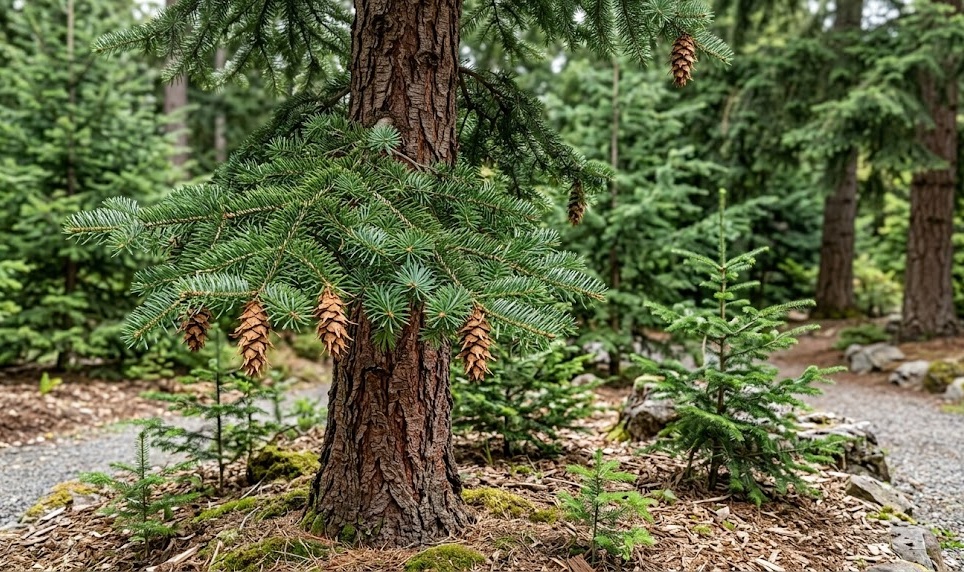

Pruning the Douglas fir is a precise horticultural task that blends artistic vision with biological necessity. While these trees naturally maintain a beautiful form, targeted trimming can improve their health, structural safety, and aesthetic appeal in a managed environment. A professional approach to pruning involves understanding when and where to make cuts to guide the tree’s growth without causing unnecessary stress. By mastering the fundamental techniques of conifer pruning, you can ensure your Douglas fir remains a strong and stunning feature of the landscape for many years.
Structural pruning goals
The primary goal of structural pruning is to create a strong, stable framework that can withstand the forces of nature as the tree grows. For the Douglas fir, this almost always means encouraging a single, central leader that points straight toward the sky. If the tree develops “co-dominant leaders,” you should select the strongest one and carefully remove or shorten the others. This prevents the formation of a weak union that could easily split during a storm or under a heavy load of snow.
Branch spacing along the trunk is another important structural consideration that you should manage through pruning. You should aim for branches that are evenly distributed around the trunk and vertically spaced so they don’t crowd each other. This “scaffold” of branches allows for better light penetration and air circulation throughout the entire canopy. Removing branches that are growing too close together or at odd angles will prevent physical rubbing and the potential for bark infections later.
The angle at which a branch attaches to the trunk is a key indicator of its future strength. Branches with a wide, “U-shaped” attachment are generally much stronger than those with a narrow, “V-shaped” union. You should prioritize the removal of branches with narrow angles, as they often have “included bark” that makes the joint structurally unsound. Early intervention when the branches are small is much easier on the tree and results in a more resilient mature specimen.
Finally, structural pruning is an ongoing process that should start while the tree is young and continue as it reaches maturity. You don’t need to do a lot of pruning at once; instead, focus on making a few key cuts every couple of years. This “little and often” approach is much less stressful for the tree and allows it to heal more quickly. By guiding the tree’s development from an early age, you minimize the need for large, dangerous, and expensive pruning jobs in the future.
More articles on this topic
Timing for corrective cuts
The best time to prune a Douglas fir is during its dormant season, typically in late winter or very early spring before the buds begin to break. During this time, the sap flow is minimal, which reduces the “bleeding” of resin and makes the work much cleaner. Pruning in the winter also allows you to see the branch structure clearly without the distraction of the new, soft growth. This is the ideal window for making structural corrections and removing any dead or damaged wood.
Late spring and early summer can also be a good time for light trimming, especially if you want to control the size or density of the tree. This is the period when you can “candle” the tree, which involves pinching off or cutting back the new, soft growth tips. By shortening these “candles,” you encourage the tree to produce more lateral buds, resulting in a much fuller and more compact appearance. This technique is often used in ornamental gardens to keep the tree within a specific size limit.
You should generally avoid pruning in the late summer and early autumn, as this can stimulate a new flush of growth. This late-season growth often does not have enough time to “harden off” before the first freeze, making it very susceptible to winter damage. Furthermore, the spores of many fungal diseases are most active in the autumn and can easily infect fresh pruning wounds. Sticking to the dormant season or the early spring “candling” window is the safest professional practice for this species.
Emergency pruning to remove broken or diseased branches can and should be done at any time of the year. If a branch is posing an immediate safety risk or is clearly infected with a spreading disease, it is better to remove it right away than to wait for the dormant season. You should make the cut as cleanly as possible and monitor the area for any signs of further issues. Protecting the health of the rest of the tree and the safety of the area is always the top priority.
More articles on this topic
Tools and sanitation
Using high-quality, sharp tools is essential for making the clean cuts that allow the tree to heal quickly and efficiently. For smaller branches, a pair of bypass pruners is the best choice, as they cut with a scissor-like action that doesn’t crush the delicate vascular tissue. Larger limbs may require a pruning saw or a pair of loppers to make a clean, one-pass cut. You should always choose the right tool for the size of the branch to avoid tearing the bark or leaving a jagged edge.
Sanitation is a critical part of the pruning process, especially if you are working on a tree that may have a disease. You should disinfect your tools with a solution of 70% isopropyl alcohol or a 10% bleach solution between each cut, or at the very least between each tree. This simple step prevents you from inadvertently spreading pathogens like root rot or needle cast from one part of the tree to another. A professional gardener is always mindful of the invisible threats that can be carried on their equipment.
When removing a large branch, you should always use the “three-cut method” to prevent the weight of the limb from tearing the bark down the trunk. The first cut should be an undercut several inches away from the trunk, followed by a second cut from the top slightly further out to remove the bulk of the limb. The final cut is then made just outside the “branch collar,” which is the swollen area of bark at the base of the branch. This technique ensures a clean finish that promotes the tree’s natural healing process.
Avoid the use of “wound dressings” or paints on the pruning cuts, as modern research has shown that they are generally unnecessary and can even be harmful. The Douglas fir has a natural ability to seal off wounds through a process called “compartmentalization,” where it grows new wood over the cut. Wound paints can trap moisture and fungal spores against the raw wood, creating a perfect environment for decay. A clean, properly placed cut is all the tree needs to take care of itself.
Maintenance of aesthetic form
For many, the natural pyramidal shape of the Douglas fir is its most attractive feature, and pruning should aim to enhance this form. You can maintain this shape by ensuring the lower branches are kept slightly wider than the upper ones, creating a balanced and stable appearance. If the tree becomes too tall for its location, you should never “top” it by cutting off the main leader. Topping causes a flush of weak, vertical growth and permanently ruins the tree’s natural structure and health.
“Lifting the canopy” by removing the lowest branches is a common practice to provide clearance for paths, views, or other plants. You should do this gradually over several years, never removing more than twenty-five percent of the living canopy in a single season. Removing too many lower branches at once can stress the tree and make it more vulnerable to windthrow. A high, clean canopy can create a beautiful “cathedral” effect in a grove of mature Douglas firs.
Thinning out the interior of the canopy can improve the overall look of the tree by reducing the amount of dead, brown needles that naturally accumulate inside. This practice, often called “cleaning,” also improves airflow and light penetration, which helps the remaining needles stay healthy and vibrant. You can do this by hand-pulling the dead needles or using a small rake to gently brush them out of the branches. This simple act of maintenance makes the tree look much more pristine and well-cared for.
Finally, always step back and look at the tree from several different angles before making a significant cut. It is very easy to get “lost” inside the branches and accidentally remove too much or ruin the symmetry of the tree. A professional approach involves constant observation and a clear vision of the desired final result. By pruning with patience and respect for the tree’s biology, you can ensure your Douglas fir remains a healthy and majestic part of your landscape.