
The successful establishment of a Douglas fir begins long before the first shovel hits the dirt, starting with a meticulous planning phase. This species is known for its impressive growth potential, but the early stages of its life are when it is most vulnerable to environmental errors. A professional approach to planting involves selecting the right genetic stock and preparing the site to meet the specific biological requirements of the tree. By understanding the nuances of both planting and propagation, you can ensure a high survival rate and a healthy start for your trees.
Selecting the right saplings
When purchasing saplings, you must prioritize the quality of the root system over the height of the tree. A tall, spindly tree with a small root ball will often struggle to establish itself and may eventually suffer from “transplant shock.” Look for specimens that have a thick, sturdy stem and a well-developed network of fibrous roots that fill the container without being “root-bound.” Healthy roots should be firm and light in color, indicating that they are actively growing and ready to expand.
The genetic origin of the sapling is another factor that will determine its success in your specific location. Trees are often adapted to the local climate of their parents, so sourcing plants from a nearby nursery is generally the safest bet. You should ask the supplier about the “seed zone” the trees originated from to ensure they are compatible with your elevation and rainfall patterns. Choosing a tree that is already acclimated to your regional conditions will significantly reduce the need for intensive maintenance later.
Examine the foliage carefully for any signs of stress, discoloration, or pest infestations before bringing the tree home. The needles should be a consistent green or blue-green color, depending on the variety, and should not fall off easily when touched. You must also check the terminal bud at the top of the tree to ensure it is intact and healthy, as this is the primary point of vertical growth. A damaged leader can result in a misshapen tree that requires years of corrective pruning to fix.
Consider the age of the sapling, as younger trees often adapt more quickly to new soil conditions than older, larger ones. While it might be tempting to buy a “mature” tree for an instant effect, these larger specimens are much harder to transplant successfully. A 2-year-old or 3-year-old sapling is often the ideal size for most planting projects, offering a balance between resilience and ease of handling. Investing in high-quality young stock is the most cost-effective way to build a lasting evergreen landscape.
More articles on this topic
Site selection and spacing
The eventual size of the Douglas fir is the most important consideration when deciding where to place it in your landscape. These trees can reach staggering heights and widths over several decades, so they must be kept far away from power lines and underground pipes. You should visualize the tree at its full maturity and ensure it will not block important views or cast unwanted shade on neighboring properties. Providing ample room from the start prevents the need for drastic removals or topping in the future.
Soil drainage and quality must be assessed at the specific planting hole location to avoid future root rot. You can perform a simple “perc test” by digging a hole, filling it with water, and timing how long it takes to drain completely. If the water is still there after twenty-four hours, the site is likely too heavy in clay and will need significant modification. You must ensure the tree is not planted in a low-spot where water naturally collects during the rainy season.
Spacing between multiple trees is vital for maintaining a healthy forest or grove environment. If you plant them too close together, they will eventually compete for light and nutrients, leading to thin canopies and weak wood. For a natural-looking grove, you should space the trees at least fifteen to twenty feet apart to allow for individual growth. If you are planting for timber or a dense screen, the spacing can be tighter, but you must plan for future thinning.
Consider the impact of existing vegetation on the new sapling’s ability to access sunlight and water. Large deciduous trees nearby might provide too much shade in the summer or drop heavy leaf litter that smothers the young conifer. You should clear a significant area around the planting site to minimize competition from aggressive grass and weeds. This “buffer zone” ensures that the young Douglas fir has exclusive access to the resources it needs during its critical first few years.
More articles on this topic
Planting techniques
The timing of the planting is crucial, with late autumn or early spring being the most favorable periods for success. During these windows, the tree is either entering or leaving dormancy, and the soil is usually moist and easy to work with. You should avoid planting during the heat of mid-summer or the deep freeze of mid-winter, as these extremes are too stressful for new roots. Proper timing allows the tree to begin root development before the demands of the growing season arrive.
When digging the hole, aim for a width that is at least twice as large as the root ball but no deeper than the current soil level. You should loosen the soil on the sides of the hole to make it easier for the new roots to penetrate the surrounding earth. It is a common mistake to plant the tree too deep, which can lead to trunk rot and oxygen deprivation for the roots. The “flare” of the trunk, where it meets the roots, should always be slightly above the final soil surface.
Carefully remove the tree from its container or burlap wrapping, taking care not to break the delicate soil and root mass. If the roots are circling the ball, you should gently tease them outward or make a few shallow vertical cuts to encourage outward growth. Place the tree in the center of the hole and ensure it is standing perfectly straight before you begin backfilling with soil. You do not need to add heavy amounts of fertilizer to the hole, as this can burn the sensitive new roots.
Water the tree thoroughly immediately after planting to settle the soil and eliminate any air pockets around the roots. You should apply the water slowly so that it soaks deep into the ground rather than running off the surface. A layer of organic mulch applied after watering will help retain this moisture and keep the soil temperature stable. Be sure to keep the mulch a few inches away from the trunk to prevent moisture-related bark diseases and insect issues.
Propagation methods
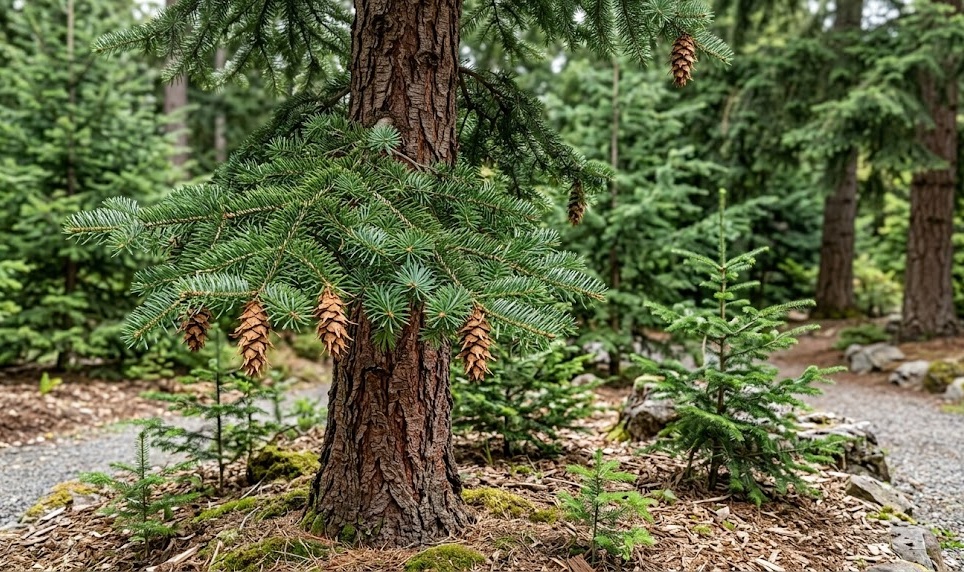
Propagating the Douglas fir from seed is the most common method used by professionals to produce a large number of trees. The seeds are typically collected from mature cones in late summer or early autumn before they have a chance to open and disperse. You must store the seeds in a cool, dry place until you are ready to begin the stratification process, which mimics winter conditions. This cold treatment is necessary to break the seed’s dormancy and trigger the germination process in the spring.
Cuttings can also be used for propagation, although this method is generally more difficult and has a lower success rate than seeds. You should take “semi-hardwood” cuttings in the late summer or early autumn from the current year’s growth. These cuttings are treated with a rooting hormone and placed in a high-humidity environment with bottom heat to encourage root formation. This technique is often used when you want to clone a specific specimen with desirable ornamental or growth traits.
Grafting is another advanced propagation technique used primarily for specialized ornamental cultivars of the Douglas fir. This involves joining a piece of the desired tree (the scion) onto the root system of a hardy, standard sapling (the rootstock). This process requires precision and a controlled environment to ensure that the vascular tissues of the two plants bond together successfully. Grafting allows for the production of unique weeping or dwarf varieties that cannot be grown reliably from seeds.
Regardless of the method used, young propagated plants require a very stable environment during their first year of life. You should keep them in a nursery setting where you can monitor their water, light, and nutrient intake closely. Protecting them from extreme weather and hungry wildlife is essential for ensuring they reach a size suitable for permanent planting. Transitioning these young trees to the field requires a “hardening off” period to acclimate them to the harsher outdoor conditions.