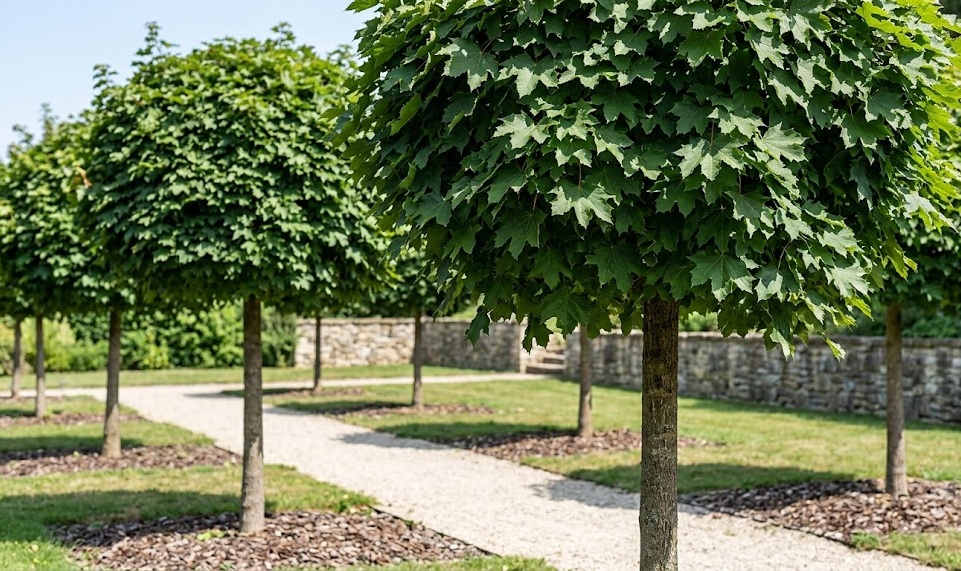

The successful establishment of a Norway maple ‘Globosum’ begins with a precise planting technique and an understanding of its propagation methods. This tree is a specific cultivar, meaning it cannot be grown from seed if you wish to maintain its distinctive spherical crown and compact stature. Most specimens available in nurseries are produced through grafting, a process that requires technical skill and a compatible rootstock. Whether you are a professional landscaper or a dedicated gardener, following the correct steps during the initial planting phase is critical for the tree’s long-term survival and structural health.
Choosing the right time to plant is the first major decision in the life of your new maple. Late autumn or early spring are the ideal windows, as the tree is dormant and the stress of transplantation is minimized. Planting during these cooler periods allows the root system to begin establishing itself before the high water demands of summer arrive. You should avoid planting during the height of summer or in the middle of a frozen winter, as the extreme temperatures can lead to transplant shock or root death.
Site preparation is just as important as the planting process itself, as it dictates the environment the roots will inhabit for decades. You should dig a hole that is at least twice as wide as the root ball but no deeper than the height of the container or burlap wrap. Loosening the soil around the perimeter of the hole encourages the roots to spread horizontally into the native soil. This practice prevents the “pot-bound” effect where roots continue to circle the planting hole rather than anchoring the tree firmly in the ground.
The depth at which the tree is planted is a factor that often determines its ultimate success or failure. You must ensure that the root flare—the area where the trunk expands at the base—is visible at or slightly above the soil surface. Planting too deep can suffocate the roots and lead to trunk rot, while planting too high can cause the roots to dry out. Professional arborists always double-check this level before backfilling the hole with soil to ensure the tree has the best possible start.
Planting process
Once the hole is prepared, you should carefully remove the tree from its container or loosen the burlap and wire cage. If the roots are tightly packed, gently tease them outward to help them integrate with the new soil more effectively. You should inspect the root system for any damaged or circling roots and prune them cleanly with sharp, sterilized tools. This step prevents future girdling roots that could eventually choke the trunk as the tree grows larger.
More articles on this topic
Position the tree in the center of the hole, making sure it is perfectly vertical and oriented in the direction that looks best for the landscape. You should backfill the hole using the native soil you removed, as this helps the tree adapt to the local soil chemistry. Avoid adding large amounts of concentrated fertilizer or uncomposted manure directly into the hole, as this can burn the sensitive new roots. Instead, focus on firming the soil gently with your hands to remove large air pockets that could cause the roots to dry out.
Watering immediately after planting is essential to settle the soil and provide the roots with the hydration they need to recover. You should apply water slowly so that it penetrates deep into the root zone without washing away the surface soil. Creating a small berm or saucer of soil around the edge of the planting hole can help direct water toward the root ball during the first few weeks. This simple structure ensures that every drop of water counts during the critical establishment period.
Staking may be necessary for the Norway maple ‘Globosum’, especially if it is planted in a windy area or has a very large crown relative to its root ball. You should use flexible ties that allow the trunk to move slightly, which encourages the tree to develop its own structural strength. The stakes should be removed after one or two growing seasons once the roots have anchored the tree securely. Over-staking or leaving ties on too long can cause bark damage and weaken the tree’s natural stability.
Grafting techniques
Since the ‘Globosum’ variety does not come true from seed, grafting is the primary method used for its propagation. This process involves taking a scion, which is a piece of wood from a healthy ‘Globosum’ tree, and joining it to a vigorous rootstock of a standard Norway maple. The most common technique used for this species is bark grafting or whip-and-tongue grafting, performed in late winter or early spring. You must ensure that the cambium layers of both the scion and the rootstock are perfectly aligned to allow for a successful union.
More articles on this topic
The height of the graft determines how tall the trunk of the tree will be before the spherical crown begins. In nursery production, these are often “high-grafted” at a height of about two meters to create the classic street-tree look. You should choose a rootstock that is healthy and of a similar diameter to the scion to increase the chances of a strong bond. Protecting the graft site with grafting wax or specialized tape is necessary to prevent the tissues from drying out and to keep out pathogens.
After the graft is made, the young tree requires a controlled environment with consistent moisture and protection from extreme temperatures. You should monitor the graft site closely for signs of “callus” formation, which indicates that the two pieces of wood are successfully knitting together. If the graft fails, the scion will wither and die, while the rootstock may try to produce its own shoots. Professional propagators often produce many more grafts than they need to account for the natural failure rate of the process.
Once the graft is established and the ‘Globosum’ scion begins to grow, the tree must be trained to maintain its single leader until the desired crown shape forms. You should remove any growth that emerges from the rootstock below the graft line immediately. These “suckers” are genetically programmed to grow much faster than the cultivar and will quickly dominate if left unchecked. Proper maintenance during the first few years of a grafted tree’s life is what ensures its future value and beauty.
Young tree care
The first three years after planting are the most critical for the development of the Norway maple ‘Globosum’. You should provide regular, deep watering during this time, especially during the dry summer months. A young tree does not yet have the extensive root system needed to tap into deep groundwater reserves. Monitoring the soil moisture daily during heatwaves will help you prevent the tree from entering a state of permanent wilt.
Mulching is particularly beneficial for young trees as it protects the fragile roots from temperature extremes and competition. You should apply a layer of wood chips or shredded bark around the base, extending out to the drip line of the canopy. This mulch also provides a visual boundary that prevents lawn equipment from getting too close to the sensitive bark. As the mulch decomposes, it gradually improves the soil structure and nutrient content in the immediate vicinity of the roots.
Light fertilization can be started in the second year after the tree shows signs of successful establishment. You should use a balanced fertilizer with a low nitrogen content to avoid encouraging excessive, weak growth. The goal for a young ‘Globosum’ is to build a strong root system and a solid framework for the spherical crown. Applying fertilizer in early spring as the buds begin to swell is the most effective timing for nutrient uptake.
Final checks during the young tree phase include monitoring for early signs of pests or diseases that can easily overwhelm a small specimen. You should inspect the leaves and stems regularly for aphids, scale, or fungal spots. Catching these issues early allows for less invasive treatments and prevents the tree from being set back in its growth. A healthy start in these early years pays dividends in the form of a robust and beautiful mature tree.