
Watering and fertilization are the two pillars that support a high-yielding onion crop throughout the summer. Onions have a shallow root system, which means they cannot reach deep into the soil for moisture during dry spells. You must provide consistent hydration to keep the plants growing steadily and to prevent the bulbs from splitting. A professional approach to irrigation combines regular monitoring with an understanding of the plant’s current growth stage.
Consistency is much more important than the total volume of water applied at any one time. Fluctuations between bone-dry soil and saturated mud can cause the onion tissues to stress and crack. We should aim to keep the top ten centimeters of soil consistently moist but never waterlogged or swampy. Using a drip irrigation system is often the most efficient way to achieve this goal in a large garden.
The early stages of growth are when the plant is building the leafy structure that will eventually feed the bulb. If the leaves do not get enough water, the plant will remain stunted and the final harvest will be disappointing. You can use your finger to check the soil moisture level a few centimeters below the surface. This simple manual check is often more reliable than any automated sensor or timer.
As the season progresses, you may need to adjust your watering frequency based on the ambient temperature and humidity. Hot, windy days can dry out the soil much faster than you might expect, requiring more frequent sessions. On the other hand, during cool or overcast weeks, you can scale back to prevent fungal issues. Flexibility and observation are the keys to a successful watering strategy for your vegetables.
Establishing a consistent irrigation schedule
A professional irrigation schedule should be based on the specific needs of your soil type and local climate. Sandy soils drain very quickly and will require more frequent, shorter watering sessions to keep the roots hydrated. Clay soils hold onto moisture longer but can become compacted and airless if they are overwatered too often. You need to tailor your approach to the unique characteristics of your own backyard or field.
More articles on this topic
Watering in the early morning is widely considered the best practice for almost all garden crops. This allows the foliage to dry out quickly as the sun rises, which significantly reduces the risk of fungal infections. Avoid watering late in the evening, as damp leaves sitting overnight are an open invitation for mildew and rot. A morning routine also ensures the plants have a full reservoir of water before the heat of the day.
You should aim for about two to three centimeters of water per week, including any natural rainfall that occurs. Using a rain gauge is a simple and effective way to track how much water your garden is actually receiving. If a heavy storm passes through, you can skip your next scheduled watering session to let the soil breathe. This data-driven approach takes the guesswork out of maintaining your onion patch.
During periods of extreme drought, you might need to increase the frequency of your irrigation to prevent the soil from cracking. Deep cracks in the earth can physically damage the delicate roots and expose the bulbs to hot air. Mulching helps to preserve soil moisture, but it does not eliminate the need for regular supplemental watering. Staying ahead of the moisture curve is much easier than trying to recover a wilted crop.
Critical moisture stages during bulbing
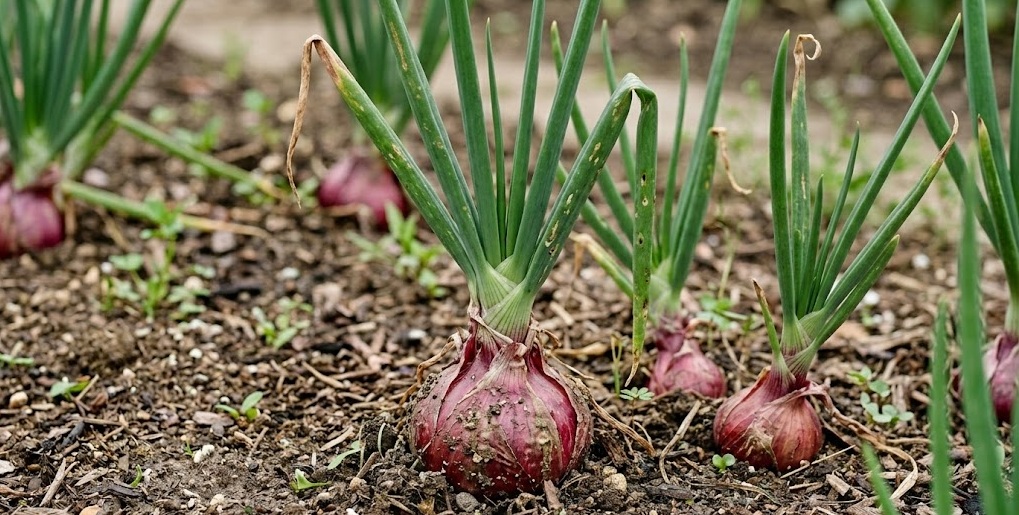
The most critical period for watering onions is during the bulbing phase, when the base of the plant starts to swell. Any significant water stress during this time will immediately result in smaller bulbs and a lower overall yield. The plant is working at its maximum capacity to move nutrients from the leaves into the storage organ. You must ensure that water is never a limiting factor during these three to four weeks of growth.
More articles on this topic
As the bulbs grow, they become more sensitive to the physical pressure of the surrounding soil. If the soil is allowed to dry out and harden, it can physically restrict the expansion of the onion layers. Keeping the earth soft and moist allows the bulb to push outward and reach its full genetic potential. Professional growers often describe this as “keeping the soil open” for the developing crop.
Once the onions have reached their full size and the necks begin to soften, you should start to reduce the water. This signals to the plant that it is time to stop growing and start the curing process while still in the ground. Too much water late in the season can lead to “thick necks” or bulbs that do not store well. Finding the right moment to pull back on irrigation is a subtle but important skill.
Finally, you should stop watering entirely about a week or two before you plan to harvest the onions. This allows the soil to dry out completely, making it easier to pull the bulbs without a lot of heavy mud sticking to them. Dry soil also helps the outer skins to begin the toughening process that is vital for storage. Managing the water at the end of the season is just as important as at the beginning.
Essential base fertilization techniques
Onions are heavy feeders that require a rich supply of nutrients from the very moment they are planted. Before you put your seeds or sets in the ground, you should work a balanced fertilizer into the top layer of soil. A standard 10-10-10 NPK mix is often a good starting point for general garden beds that have not been tested. This provides a steady supply of nitrogen, phosphorus, and potassium for the initial growth spurt.
Phosphorus is particularly important during the early stages of development to encourage strong root growth. A robust root system allows the plant to access water and nutrients more efficiently throughout the entire summer. You can add bone meal or rock phosphate to the planting furrow if your soil is known to be deficient. Professional gardeners know that the foundation of the plant is built in the first few weeks.
Potassium plays a vital role in the overall health and disease resistance of the onion plant. It also helps with the formation of the cellular structure of the bulb, which improves its storage life after harvest. You should ensure that your base fertilizer includes a sufficient amount of this essential macronutrient. Organic options like wood ash or greensand can be used to boost potassium levels in a sustainable way.
Avoid over-fertilizing with nitrogen at the very beginning of the season, as this can lead to excessive leaf growth at the expense of the roots. The goal is to create a balanced plant that is sturdy enough to support a large bulb later on. Incorporating well-rotted compost into the soil also provides a slow-release source of nutrients that lasts for months. A thoughtful approach to base fertilization sets the stage for a productive year.
Nitrogen management and top-dressing
Nitrogen is the fuel that drives the production of the green leaves which, in turn, create the onion bulb. Each new leaf the plant grows represents another layer that will eventually form part of the harvested onion. Because onions have a limited root zone, they often benefit from supplemental nitrogen applications during the vegetative phase. This practice is known as “top-dressing” and is a standard technique in professional agriculture.
You should apply a high-nitrogen fertilizer every three to four weeks until the bulbing process begins. Ammonium sulfate or blood meal are common choices for providing a quick boost of nitrogen to the growing plants. Simply sprinkle the fertilizer along the rows and then water it in thoroughly to help it reach the root zone. You must be careful not to let the fertilizer touch the leaves directly, as it can cause chemical burns.
Stop applying nitrogen as soon as you see the bulbs starting to swell and push the soil aside. Continuing to feed the plants with nitrogen at this stage will encourage continued leaf growth instead of bulb development. This can result in onions with very thick necks that are prone to rotting and do not cure properly for storage. Timing your last application correctly is one of the most important parts of nutrient management.
The amount of nitrogen you need will depend on the initial fertility of your soil and the specific variety of onion. Large, long-day storage onions generally require more feeding than smaller, quick-maturing green onions. Observing the color of the leaves can give you a clue about the plant’s current nitrogen status. Dark green, vigorous leaves indicate a healthy supply, while pale or yellowing leaves may signal a deficiency.
Balanced micronutrient application
While nitrogen, phosphorus, and potassium are the major players, onions also need a variety of micronutrients to thrive. Elements like sulfur, zinc, and manganese are required in tiny amounts but are essential for various biological processes. Sulfur, in particular, is responsible for the characteristic pungent flavor and aroma that we associate with onions. If your soil is very sandy or depleted, the plants might suffer from subtle micronutrient deficiencies.
Foliar feeding is an excellent way to deliver these trace elements directly to the plant’s circulatory system. You can spray a diluted liquid seaweed or kelp extract onto the leaves once or twice during the peak growing season. These organic liquids contain a wide array of minerals and growth hormones that can give the plants an extra edge. The leaves absorb these nutrients much faster than the roots can take them up from the soil.
Boron is another micronutrient that is often overlooked but is vital for proper cell wall formation in the bulb. A deficiency in boron can lead to hollow hearts or internal browning, which ruins the quality of the harvest. You should only add micronutrients if a soil test indicates a specific need, as excessive amounts can be toxic. Professional gardening is as much about precision as it is about hard work and dedication.
Maintaining a proper soil pH is the best way to ensure that all nutrients are available to the onion plants. If the soil is too acidic or too alkaline, many minerals become chemically locked and the roots cannot absorb them. Adding lime to raise the pH or sulfur to lower it is a common long-term strategy for soil management. A healthy soil chemistry is the hidden engine that drives a successful and professional gardening operation.