
Understanding the light requirements of the Douglas fir is essential for any professional gardener or forester aiming to maximize the growth and health of this species. As a tree that naturally thrives in the diverse light conditions of the forest, it has developed specific physiological responses to the quality and duration of sunlight it receives. A professional approach to light management involves placing the tree in the optimal position and managing the surrounding environment to ensure it gets exactly what it needs. By mastering this aspect of care, you can influence everything from the density of the foliage to the overall structural strength of the tree.
Photoperiodism and growth cycles
The Douglas fir is highly sensitive to the length of the day, a biological phenomenon known as photoperiodism. This internal clock tells the tree when to start growing in the spring and when to begin preparing for dormancy in the autumn. As the days lengthen, the tree’s hormones trigger the swelling of buds and the production of new needles. Conversely, the shortening days of late summer signal the tree to stop its vertical growth and focus on hardening its wood for the coming winter.
Light quality, specifically the ratio of red to far-red light, also plays a role in how the tree perceives its environment. In a dense forest, the upper canopy filters out much of the red light, leaving more far-red light for the trees below. The Douglas fir responds to this “shade signal” by stretching its leader upward in an attempt to reach more direct sunlight. This is why trees grown in crowded conditions are often taller and thinner than those grown in open, sunny fields.
Seasonal variations in light intensity must also be considered when managing these trees in a landscape setting. During the peak of summer, the intense sun can sometimes lead to “photo-inhibition,” where the tree actually slows down its photosynthesis to protect itself from damage. Providing some afternoon shade in very hot, southern climates can actually help the tree maintain a more consistent growth rate. Understanding these subtle responses allows you to fine-tune the tree’s environment for maximum efficiency.
Artificial light sources, such as streetlights or security lamps, can sometimes disrupt the natural photoperiod of a tree planted near a home or road. If a tree is exposed to light twenty-four hours a day, it may fail to go dormant properly in the autumn, leading to severe winter injury. You should try to place your Douglas firs in areas where they can experience natural cycles of light and dark. Maintaining this natural rhythm is crucial for the tree’s internal chemistry and long-term survival.
More articles on this topic
Full sun vs partial shade
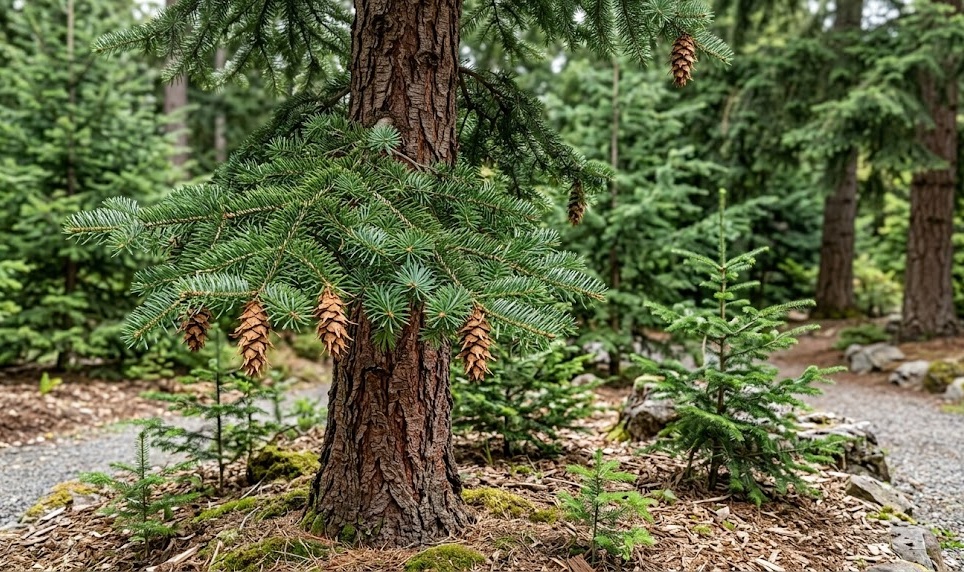
In its natural habitat, the Douglas fir is often considered a “seral” species, meaning it is one of the first trees to colonize an area after a disturbance like a fire. This means it is highly adapted to full sun conditions and performs best when it receives at least six to eight hours of direct light daily. A tree grown in full sun will typically have a more robust trunk, shorter internodes, and a denser, more symmetrical canopy. For most landscape applications, a sunny location is the primary recommendation for this species.
However, the Douglas fir is also surprisingly shade-tolerant, especially during the first few years of its life. Young saplings often grow in the filtered light beneath the canopy of larger trees, which protects them from extreme heat and moisture loss. You can successfully plant this species in areas that receive partial shade, provided they still get a few hours of direct light. The tree will grow more slowly in these conditions, but it will often develop a very graceful and open form that some find more attractive.
As the tree matures, its demand for light increases as it tries to become a dominant member of the canopy. An older tree that finds itself heavily shaded by newer structures or faster-growing neighbors will begin to show signs of stress. You might notice the lower branches dying off more quickly than usual or the needles becoming thin and pale. This “self-pruning” is the tree’s way of shedding energy-consuming parts that are no longer contributing to its growth through photosynthesis.
When choosing a planting site, you must consider how the light patterns will change over several decades as other plants grow and buildings are constructed. A spot that is perfectly sunny today might be in deep shade twenty years from now, which could compromise the long-term health of your tree. You should aim for a location that offers “permanent” light access to ensure the tree remains vibrant throughout its entire lifespan. Planning with the future in mind is the hallmark of a truly professional landscape design.
More articles on this topic
Impact of light on needle density
The amount of light reaching the needles directly determines how many chloroplasts are produced and how much energy the tree can generate. In high-light environments, the Douglas fir produces “sun needles,” which are thicker, tougher, and more efficient at processing intense radiation. These needles are also more closely spaced along the branch, giving the tree the full, lush appearance that is so highly prized. A well-lit tree is a dense tree, offering better privacy screening and a more impressive visual impact.
Conversely, needles grown in low-light conditions, known as “shade needles,” are thinner and more spread out to capture as much of the limited light as possible. While this allows the tree to survive in the understory, it results in a much more “leggy” and transparent appearance. If you want a thick, impenetrable evergreen hedge or focal point, you must provide the tree with ample sunlight. Light management is essentially the same as “density management” when it comes to conifer care.
The internal parts of the canopy will naturally be shadier than the outer edges, leading to a gradient of needle types within the same tree. You can improve the light penetration into the center of the tree through careful thinning of the branches. This allows more light to reach the interior wood, which can stimulate dormant buds and lead to a fuller interior. A professional arborist knows how to prune a tree to maximize its “light harvesting” potential without compromising its natural form.
Monitoring the color of the needles can also tell you if the light levels are correct for your specific specimen. Needles that are a deep, dark green are usually a sign of a tree that is perfectly adapted to its light environment. If the needles look washed out or yellowish, it could be a sign of too much light (sunburn) or not enough light for proper chlorophyll production. Adjusting the light levels, either through pruning or moving nearby obstructions, can often restore the tree’s vibrant color.
Shadow management in mixed groves
In a grove or a mixed-species planting, the interaction of shadows between different trees is a complex and dynamic factor. Faster-growing deciduous trees can quickly overtop a young Douglas fir, depriving it of the light it needs during its critical establishment phase. You must be prepared to “release” your conifers by pruning back the branches of competing trees that are casting too much shade. This active management ensures that all the members of your grove have the resources they need to thrive together.
The orientation of the rows in a plantation or a large garden can also influence how much light each individual tree receives. Planting in a north-south orientation generally provides more even light distribution to both sides of the tree as the sun moves across the sky. In an east-west orientation, one side of the tree may be in constant shadow, leading to asymmetrical growth and a “one-sided” appearance. Professional foresters always consider the sun’s path when designing the layout of a new planting.
Reflected light from nearby water features, light-colored walls, or even snow can provide a significant boost to a tree’s energy intake. You can use this to your advantage by placing trees in positions where they can benefit from this “bonus” light, especially in darker or north-facing gardens. However, you must also be careful that the reflected light is not so intense that it causes bark damage or needle scorch. Using the surrounding environment to manage light is an advanced technique that yields great results.
Finally, remember that light and water are closely linked in the tree’s physiology; a tree in full sun will always need more water than one in the shade. You must balance your irrigation schedule with the amount of light the tree is receiving to prevent drought stress. A professional approach means looking at the tree’s needs as a whole rather than in isolation. By providing the right amount of light and the resources to process it, you ensure the health and longevity of your Douglas fir.